fragments and reflections
Fragments & Reflections
Ain’ters Gonna Ain’t
I realize that social media is an inept form of communication. But that shouldn’t be an excuse for vitriol, divisiveness or exclusion.
A recent posting of one of my “friends” in which they promoted the Christian faith of “one of [their] favorite presidents.” After which they say, “Haters, please don’t comment.”
The posting and use of words, of course, is completely non-shocking. We see this type of comment on social media all the time. (We see it on Obama and on Bush and on everything across the polemical gammut.) It is common, and that is why it should be all the more disturbing.
We could critique the actual statement that affirms the president’s Christianity on the basis of his stated belief in Jesus or his attendance of church or the prayer he has prayed – a statement that may implicitly give the president blanket approval, without evaluating how the particular president’s actions cohere with Christian faith. We could critique that.
We could also critique this form of communication that claims the soapbox or the pulpit for one’s self and for one’s self alone. The exclusive right to speak assures a monolog. Or it assures a dialog only with those who think like you. And that limits any liklihood of learning or change. It says I want to talk but I don’t care about lisenting. It says my voice is important and yours is not. In larger society, this is counter the value of “free speech,” which their favorite president presupposably supports. In the church, this is the equivalent of silencing the prophet, whose contemporaries would have called “hater.”
And that leads to the real problem with this statement. It is easy to throw around words like “hater.” It’s not just that this is simple “name-calling.” It demonizes the other. It’s not that you have a different opinion than I; it’s that because you have an opposing opinion, you are bad. And because you are bad, no one needs listen to you. Worse, your being a “hater” justifies my violence against you, whether that be denying you the right to be heard or by inflcting other harms on you.
So, let’s take a line from The Interview, a film which has become a metonymic image of threatened free speech and violence to another’s point of view. Actually, we’ll take just the second half of James Franco’s character’s line, “Haters gonna hate an ain’ters gonna ain’t.” Let’s be ain’ters, refusing to demonize the other as hater and refusing to shut down those with views contrary to our own.
Faith By Receiving A Child
We have just concluded the Advent Fast. On the Eastern Orthodox calendar that we follow in Romania, it is 40 days of anticipation, austere eating and waiting that culminate in the joy, feasting and receiving at the Messiah’s nativity. As we progress liturgically through Christmastide and Epiphany, the theme of receptivity remains before us. Shepherds and Magi stand in contrast to innkeepers and Herod. Joseph struggles. Mary consents. Simeon and Anna rejoice. Yet, the common response to Jesus was not reception but rather rejection. “He came to what was his own, and his own people did not accept him. But to all who received him, who believed in his name, he gave power to become children of God” (John 1:11-12).
What does receptivity look like for us? It is a profound grace that we, mere creatures, are given the possibility to show hospitality to our Creator. Yet, the distractions and confusions easily inhibit our “well-coming” Him. Even when we manage to move beyond the gift exchanges, seasonal feasts and sparkling decor to contemplate God’s coming in flesh to creation, we can still domesticate receptivity. It may look like an imaginative act of cuddling the newborn baby or the inviting of the Christ Child into our hearts. While there may be value in these meditations and prayers, they tend to reduce “receiving Jesus” to “believing in Jesus” – and by “believing” we mean placing our faith in God. Unfortunately, “faith” for us usually means believing the right things in the right way or giving intellectual assent to that which cannot be proven. While these aspects might need to be integrated into faith, they do not do justice to the biblical picture of faith. There is something more, something richer.
 Just as the Father gave the Son to be received, so Jesus tells us to receive a child (Matthew 18). Receiving a child doesn’t mean putting our faith in the child. It means recognizing, welcoming, protecting, and raising the child. Jesus says that we must do this if we want to enter the kingdom of God (Matthew 18:2-5). This doesn’t mean that when we receive a child, we have a ticket to heaven. While the kingdom of God is much more than an eternal destination, it definitely does involve salvation (healthy life, peace, restoration, etc.). Connecting the receiving of a child with salvation may cause an allergic reaction in good Protestants, who pride themselves in grace alone and faith alone. But this is where we are invited to go deeper. Receiving the child that Jesus places in our midst is nothing less than a call to faith.
We have satisfied ourselves with cheap, fickle and superficial faith. Faith can be intellectual or emotional, but unless it is active, it is not faith. Faith cannot be separated from faithfulness. This is illuminated in a parallel text in Mathew 19. There a rich young man comes to Jesus, wanting to be assured of eternal life. The young man tells Jesus that he has kept the Torah. Jesus tells him that the one thing he must still do is to sell all his possessions and give the money to the poor. The rich young man couldn’t do this, so he walked away sad. Jesus invited him to faith, and this faith included eternal life. While we probably would have asked the young man to raise his hand, come to the altar, or to say a prayer, Jesus calls him to a faith-filled action: sell everything and provide for the poor. Thankfully for us, Jesus no longer talks like this. Or does He? We are inclined to stay safe in our self-made homes of faith and to convince ourselves that there we offer hospitality to Jesus. But if we risk being confronted by the God who says “Receive Me” and “When you receive this child, you receive Me,” then we will walk out into the daring and dangerous space of God where receiving means giving, life means dying, and salvation means caring for vulnerable. Faith in the kingdom of God means faithfulness. Without faithful actions, there is no faith.
To make sure that we get the message, Jesus also shows us the other side of the coin. When we don’t receive the child, when we despise or impede the child, we will suffer harsh judgment (Matthew 18:6-10). The consequences of our faithfulness are normally suffered by the vulnerable, little children. But God sees and God will act justly. In just a short section of the Gospel, it is all there: kingdom of God, salvation, judgment and the invitation to faith and discipleship.
This past summer we met Silvia. She lives in a crumbling house on the same street as our Community Center. Like many children in our neighborhood, Silvia is severely neglected. Both of her parents suffer from alcoholism. Her father is abusive. She has been raised more by her brother and sister than her parents. Silvia suffers from under-nutrition and a speech impediment. More than these physical detriments are the spiritual and emotional ones: her face, reveals fear, hurt and confusion.
In our community we are daily confronted by children like Silvia. We recognize her as “a child placed in our midst.” Jesus said, “Whoever welcomes one such child in my name welcomes me” (Matthew 18:5). Just as with Jesus in the manger, so also with the pericopes of Jesus’ interaction with children: it is too easy for us to be moved by sentimentalism or romanticism. We think that we just need to get down on a knee and give the child a hug. But a hug for Silvia is at best insufficient and at worst inappropriate. What then does it mean to welcome such a child in Jesus’ name? 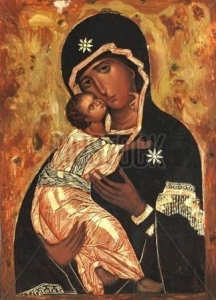
It means being-with Silvia. It means directing our attention to her. It means creating safe space for her. As we get to know Silvia, we are looking at helping her physical needs through doctors and dentists. We are supporting her schooling and exploring speech therapy. More delicately, we are relationships with her parents and siblings and asking ourselves what kind of community support we can help develop for their family to move in a healthier direction. We pray that our receiving is done well and done responsibly and that it affirms faith in Jesus.
Jesus places a child in our midst and invites us to faith in Him. Faith is faithfulness: receiving the child, loving sacrificially, giving everything away to care for the poor, taking up our cross, and following. Mysteriously, when we are attending to the salvation of the little ones, we are being saved. When we are receiving the child in the name of Jesus, we are being received as children of God. That is saving faith.
Fumbling Beatitude
I was asked to speak on globalization and re-read an article I wrote in 2001. Although I would state things differently today, I post it here:
“Blessed are you who are poor, for yours is the kingdom of God” (Luke 6:20). This bold opening to the Sermon on the Mount sets the pace of a manifesto that continues to riddle me with seeming contradiction. The other day a young pregnant girl came to me begging for food. “I haven’t eaten in three days!” she explained. Every day we meet some 20 children who live on the streets. They arrive with torn clothing, failing shoes and bruised bodies. How can I affirm that these poor ones are blessed?
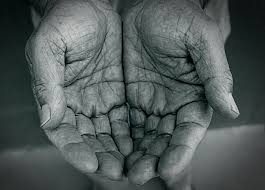 “For the poor you have with you always; but you do not always have Me” (Matt. 26:11, Mark 14:7, John 12:8). These words of Jesus often are quickly cited when discussing Christianity and the Poor. Unfortunately, we are usually displaying our ignorance and siding with the disciples who thought that the money “wasted” on Jesus would be better spent on the Poor; or we are making ourselves feel better about the fact that the poor exist and that we do so little about it. Those –like me –, who read Jesus’ words from the perspective of the dominant culture, use the poor as objects of their patronizing pity or excuses for not giving at all. Though I do think that the existence of the poor has value in that God invites us to meet Him in the presence of the poor, I do not think we understand Jesus’ words in context. Jesus is quoting from Deuteronomy 15:11. “For the poor will never cease to be in the land; therefore I command you, saying, ‘You shall freely open your hand to your brother, to your needy and poor in your land.’” (We should take special note of the possessive pronoun that precedes the poor and the synonym “brother” which implies that the poor are part of our responsibility and family.) But the poor are not always with us merely so that our hands remain open. A few verses prior God states, “There shall be no poor among you, since the Lord will surely bless you in the land which the Lord your God is giving you as an inheritance to possess” (Deut. 15:4). There should be no poor among us. Yet, God knows the wickedness of our hearts and the power of greed. He knows that this will cause poverty, but He commands us to bring them into our families and give to them. If we obey, there will be no poor and we will be freed from our greed. If there are to be no poor, then why does God bless the poor? Why does God bless something that He forbids?
If we look to the Church of the New Testament, we see that God faithfully moves His people to jubilee. “For there was not a needy person among them, for all who were owners of land or houses would sell them and bring the proceeds of the sales… (Acts 4:34). A sign of the presence of God in His Church is that there are no poor.
Then, we must ask, why are the poor blessed? There is nothing romantic about the brutality of poverty: starvation, powerlessness, ignorance, and death. The poor are not blessed because they are poor but because the Kingdom is theirs. “God loves the poor with a special love because they are poor and not necessarily because they are good. The Beatitudes tell us more about the goodness of God than about the goodness of the poor. They reveal a Go’el God, defender and protector of the real-life poor, those deprived of what is necessary to live as human beings. It is this condition that makes them the preferred people of God” (Gutierrez).
The privilege of the poor, then, has its theological basis in God. But there is also a blessing in the culture of the poor. I do not say this so that we spiritualize the words of Jesus. “If we ‘spiritualize’ the gospel message about the poor…and maintain that the ‘poor’ in the gospel are first and primarily the ‘spiritually’ poor rather than plainly and simply the materially poor…then we have an easy time with God. We ‘humanize’ God. We make him more accessible to human understanding. Now God will love, first and foremost, the good, the ‘meritorious’ – just as we do ourselves” (Gutierrez). The poor are not blessed because they have a virtuous culture but because the Kingdom manifests itself in their midst. The blessed recognize their need for God and recognize their dependence on God. The blessed are free from commitments to the world. The blessed see how much they have to give out of the little that they have. The blessed value people, relationships and gratitude.
Really, if we are to say with Jesus that the poor are blessed, we must see the poor through Jesus. Jesus is the One who although rich made Himself poor, and He is inviting us to Himself through the poor. For that very reason, there should be no poor because we all look to love God who reveals Himself in “the least of these.”
My hungry friend, who is a pregnant street girl, is blessed because the Kingdom is hers. Her poverty is not romanticized or glorified. Rather, it is forbidden. OK, if you are in a hurry and have been readily reading through this article up to now, then I advise you not to read the rest. So, seriously, put it down and I won’t be in the slightest bit upset. The essence of what I wanted to say has been said. Hereafter, I want to draw your attention to two ways our skewed logic about the blessed poor have affected society. But this will take a little bit of space. The first is that the poor lost their blessedness to the Church. The second is that we have objectified the poor.
The early Church knew that God loves the poor. A pagan historian reported from pre-Christian Rome that the Christians cared not only for their poor but for all of Rome’s poor as well. In fact, the theological question for the Church of the day was not “why are the poor blessed” but “how can the rich be saved” (Clement of Alexandria). Unfortunately, the Church gradually surrendered their responsibility of caring for the poor to the state. Kings and governors took charge of social programs. Of course, the Church often led the way in developing care for the poor, but the centrality of the blessed poor was lost. The Reformation furthered this loss. When the reformers did away with monasticism and almsgiving as ways to gain heaven by works, they also did away with the need for obedience to economic matters. The Enlightenment followed the path of the Reformation. The enlightened thinkers divided church and state and made the state responsible for its poor. In countries like England, the Church had great influence in the decisions of the state, but the poor remained the responsibility of each city. Unfortunately, this social policy changed as cities became more industrial and more capitalistic. The basis of capitalism is the free individual. But when a society makes the individual the central category, it quickly sacrifices equality and marginalizes anyone who cannot compete. The sanctification of democracy, capitalism and individualism has left the church wondering why the poor were ever called blessed.
When we do not treat the poor as blessed ones or as human beings, we objectify them. I want to give you a recent example. In the 2001 first quarter edition of World Vision’s journal, Global Future, Mike Moore (the Director-General of the World Trade Organization) speaks positively of the benefits of globalization on the poor. His distorted analysis of open markets improving national economies leads to his naïve assumption that the poor actually enjoy the benefits of their countries economic growth. I apologize for quoting Moore so extensively:
It is people in Britain who can talk on Finnish mobile phones, use Japanese cameras, drive American cars, drink Colombian coffee and wear clothes made in Asia. It is poor people everywhere who can buy cheaper food and clothes produced abroad. It is Indian computer programmers who can sell their services to American companies, and earn enough to give their children a good education and decent health care. And it is poor people in poor countries who are grasping the opportunities provided by trade and technology to try to better their lives. Mexican farm hands who pick fruit in California, Bangladeshi seamstresses who make clothes for Europeans…They and countless other real people everywhere are the human face of globalization.
I want to comment on these words. Many would say a loud amen to Moore’s myopic optimism. Regrettably, I know few poor people who can buy imported products. Implicit in the word “poor” is lack of money, power and access. The young pregnant street girl I know only gets more depressed when she sees the imported food and clothing that she cannot buy. Also, I wonder if Mr. Moore knows about exploitation of coffee farmers in South America or the amount of aid the U.S. government gives to Colombia each year. Concerning the globalization of labor, I would introduce Mr. Moore to the Indian computer programmers I know. They are either working long hours for wages incomparable with their western counterparts, or they have joined the brain drain and have left their families and cultures so that their families can survive the industrial age in which a minority flourishes. I agree that the poor are resilient and try to use global trade and technology to their advantage, but this is rarely possible for the truly poor. Frankly, I cannot believe that Moore would draw our attention to Mexican workers in the U.S. or Bangladeshi seamstresses and call it a good thing. Their hard lives prove that the development is built on the backs of the poor and oppressed, and as long as capitalism is driven by greed and a lack of ethics, the trend will continue to worsen. The human face of globalization, I am afraid, is brutalized and dehumanized. At least Mike Moore makes no qualms about the company he keeps: It is not just Wall Street traders, management gurus, everyone who enjoys a comfortable pension and foreign investments, and “international civil servants like myself who gain from globalization.” I am of the opinion that we devalue terms like “civil” and “servant” when they are applied to people who share Mike Moore’s views. But I am painfully aware that when we benefit from a structure – be it good or evil – like global capitalism, we will paint its effects with beautiful colors only so we can continue to reap its benefits. Reality bites when we see that we are the benefactors of such a system, and the effects on the poor are brutalizing.
When Jesus speaks, we need to listen. When we don’t, the effects are disastrous for society. The Church can no longer throw off the Beatitudes because she thinks them too idealistic. For it is evident that the Church loses relationship with the poor and objectifies them when she does not understand why the poor are blessed. The very real sign of our misunderstanding are street girls that get pregnant before their time and go for days without eating. But God says to her: You are blessed! The Church needs to walk with her and help her discover this blessing.
The Situation in Romania 2014
 Every few years I try and compile some general statistics that give you an idea of the situation in Romania. I have compiled the following from various news reports, surveys, studies and government reports. I hope this provides you with a window through which you can understand a little bit of the context in which we serve, the challenges we face, and the reasons for doing what we do.[1]
While there may be progress, development or improvement in some areas, I present here a perspective from the lower class and the most vulnerable. Our hope and prayer is that their situation will change than they will experience a better future.
The Government
Our vulnerable friends’ experience with the government is listening to the campaign promises and then waiting another four years to see them again.
Street protests against economic hardship, corruption and government authoritarianism in 2012 led to the collapse of the governing coalition. In addition, the government has gone through the turbulence of repeated attempts to impeach the president Traian Basescu. We will have a new president this year. Elections will be held in November. Only recently has the investment grade risen after years of political turbulence. Hopefully, a semblance of stability will continue even in the face of regional conflicts and the harsh rhetoric that has ensued.
Corruption
Romania placed 69 out of 177 countries on the corruption index.[2] The Romanian parliament voted to exempt themselves and several other government officials from anti-corruption laws, which refer to actions such as abuse of office, bribery, and conflicts of interest by public officials, the law would no longer apply to them. According to the anti-corruption prosecutor’s office (DNA), 28 members of Parliament have been convicted or are on trial for various corruption charges. In addition, 100 mayors and vice-mayors are being investigated for such crimes as awarding contracts to family and friends.[3] In our daily experience, there are still frequent implicit requests for bribes by medical practitioners, government officials, police officers and teachers.
NATO
 Romania is a strategic partner in the North Atlantic Treaty Organization (NATO), and it has provided significant contributions of troops, equipment, and other assistance in Afghanistan and Kosovo.[4] Romania has agreed to host elements of the U.S. Phased Adaptive Approach to European missile defense in the 2015 timeframe. The two countries signed a ballistic missile defense agreement in 2011 allowing the deployment of U.S. personnel, equipment, and anti-missile interceptors to Romania over the next five years. The United States and Romania also have adopted the bilateral Joint Declaration on Strategic Partnership for the 21st Century. The strength of NATO is now being tested in Romania and other countries on the alliance’s eastern border, as it faces the crisis in Ukraine.
The Economy
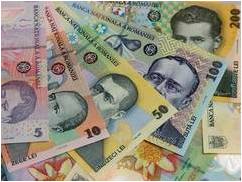 Romania’s original target date for adopting the Euro was 2015, but the president stated that it was unfeasible. Romania’s GDP is between 50% and 55% lower than the Eurozone’s average.[5] For the past few years, the government has continually overestimated economic outputs, resulting in budget deficits. But in the first quarter of 2013, Romania’s economy began to expand, although less than the government forecast. It grew by 3.5% in 2013 – due to a bumper harvest – with a predicted 4.2% growth in 2014.[6]The country’s inflation rate in 2013 was 4.4%, Europe’s fastest, but is forecast to fall to 3.5% on average in 2014 as gradual government deregulation boosts energy prices. Currently, the country is authorizing and protesting policies concerning gold mining and land and water fracking. S&P recently upgraded Romania to investment grade after the economic crisis of 2008.[7]
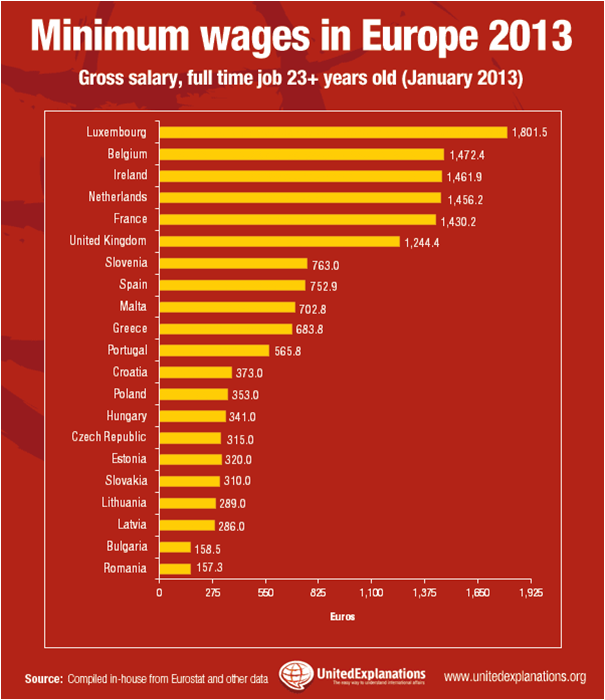 The average individual income is less than 350 Euros a month. In 2014, the minimum wage is being increased in two stages to RON 900, from the current RON 800 (USD$245). After several years of strong growth in the 2000s, Romania has been hit hard by the 2009 global recession and the Eurozone crisis, which have revealed systemic weaknesses in its economy.
Romania relied on a 20 billion-euro loan from the IMF between 2009 and 2011 to help it emerge from a two-year recession and withstand external shocks from the global financial crisis. As part of the loan agreement, the government cu public sector wages by 25% and raised the value-added tax from 19% to 24%.
 The official unemployment rate is 7.2%.[8] The lack of jobs is one of the primary drivers of people migrating out of the country. Still, there is an estimated 2.3 million Romanians working on the black market, more then a third of those legally employed.[9]
In Galati, ArcelorMittal Sidex, the steel factory and largest employer, has not registered a profit since 2008 and has laid-off 19,000 workers in the past 11 years. So, the economic outlook for Galati is not great.[10]
Agriculture
 25 years have passed since the fall of communism and the restoration of property confiscated by the communist regime to their owners is still in process. Approximately 3 million hectares of arid land out of the 12 million has not been restituted, and almost 5 million of the hectares are split up in sections smaller than 1 hectare. This shows a lack of a united vision and efficient planning of agricultural land.[11] So, although Romania has the capacity to feed 80 million people, it continues to import most of its food. The question remains: if the land was managed efficiently, who would cultivate it? The average yields are less than half of that of the EU. For its agricultural development, 300 million Euros are being loaned to Romania.[12]
Poverty
Absolute poverty declined from 35.9 percent in 2000 to 5.7 percent in 2008.[13] Still, Romania is the European Union’s second-poorest state. Some 9.5 million people, or roughly half of the population, are receiving welfare, unemployment, housing and central heating aid, or other supplemental benefits on a monthly basis. That equates to a national expense of $3.2 billion a year.[14]
One-fourth of young adults (ages 18 to 24 years old) live in relative poverty, the highest rate in the EU. 40% of this age group are at risk of social exclusion.(DPC report).[15]Because of their lack of buying-power, youth are forced to live with their parents into adulthood, thus increasing the family size. About 45% of those with full-time jobs still live with their parents, compared with 38% in the EU.[16]
Emigration and Migrant Orphans
Shortly after the 1989 so-called “revolution,” Ryszard Kapuściński said that the people abolished the dictator, not so that they could turn to the building of democracy, but so that they could open up the borders and leave.[17] According to the latest census that was taken in 2011, Romania lost 2.68 million inhabitants in the last 10 years.[18] The greatest loss of population in all of Romania was in Galati, which dropped 22.56% – from 298,589 in 2002 to 231,204 in 2011. It is now the 5th largest city in the country.
Romanians abroad are expected to send about USD 3.6 billion to their home country in 2013, making it the third largest volume of remittances to a developing country in the region (behind Poland and Russia), according to a recent World Bank report. The amount sent to Romania in 2013 is expected to be almost flat on 2012, and smaller than in 2011, when it reached USD 4.5 billion, as well as from 2010, when it stood at USD 4.9 billion.[19]
Over the past year, there was much negative press in the UK as they removed travel restrictions on Romanians and Bulgarians. Although they expected to be overwhelmed by the flood of Romanian and Bulgarian immigrants, the total of 140,000 citizens from Romania and Bulgaria employed in Britain between January and March represented a decline of 4,000 when compared with the 144,000 in work in the last three months of 2013.[20] Still, the stigma on Romania immigrants remains in many circles.
 According to the Soros Foundation, Romania has about 350,000 children who are left without parents. The Romania Authority for Child Protection’s figure is much lower, stating that at least 82,000 children have at least one parent that has gone to work abroad. There have been reports of children as young as 12 killing themselves after their parents left.[21] Some of these children also suffer from mental illnesses such as depression and often have trouble in school. Many drop out of school. Additionally, some may turn to crime and drugs to cope with their issues. Recently, new laws have been passed in Romania which will place fines up to 2,500 Euros for parents who do not leave children with appropriate guardians.[22]
Children in Poverty
In the 1990s, Romania had over 6.6 million children. Today, due to a lower birth rate, there are 3.7 million children.[23] As the birth rate falls, the life expectancy has increased, resulting in there being 1 child to every 2 adults in the 1990s to 1 child for every 4 adults today.
Over half of Romanian children are at risk of poverty and/or social exclusion, and one third lives in persistent poverty.[24] The rate is highest in families with many children or with a single parent. About one in 10 children live in homes with no working adult. The rate of material deprivation is 3 times higher than the EU.[25]
Poverty exists even where parents are working. One in three children live in poverty even where parents are working. One in every five families that have working adults still lives in poverty, and this rate is rising.[26]
About 12% of rural households have no income other than the state subsidy for children. [27] 10% of these children go to bed hungry and 12% are missing school so that they can work.
Sex Workers/ Child Trafficking
Girls and boys left without their parents are extremely vulnerable to being trafficked. Romania is a source, transit, and destination country for men, women, and children subjected to forced labor and women and children subjected to sex trafficking. Romania has become a major transit for the sale of people into the European Union. Victims as young as 12 years old are trafficked into Romania from destinations as far-reaching as Honduras, Afghanistan, the Congo, and China. Once they reach Romania, many of these victims are assigned for passage beyond into Western Europe. While Romanian law officially prohibits all forms of human trafficking, the country’s strategic geographic location — a crossroads between East and West — makes it a source, transit and destination country for the people trade. The country’s 2007 admission into the European Union brought more relaxed border regulations and enhanced its attraction for international human traffickers.[28]
According to the US State Department, Romanians represent a significant source of trafficking victims in Europe.[29] Romanian men, women, and children are subjected to forced labor in agriculture, domestic service, hotels, and manufacturing, as well as forced begging and theft in European countries. Children likely represent at least one-third of Romanian trafficking victims. Traffickers recruiting and exploiting Romanian citizens were overwhelmingly Romanian themselves. Frequently, traffickers first exploited victims within Romania before transporting them abroad for forced prostitution or labor. The Romanian government reported increasing sophistication amongst Romanian criminal groups, including the transportation of victims to different countries in Europe in order to test law enforcement weaknesses in each. The Government of Romania does not fully comply with the minimum standards for the elimination of trafficking; however, it is making significant efforts to do so. The government reported the identification of 1,043 victims in 2011.[30] The government made strong prosecution efforts during the reporting period: the number of anti-trafficking prosecutions pursued was amongst the highest in Europe (480 prosecutions with 276 convicted in 2011), and built on partnerships with governments in destination countries to increase accountability for trafficking offenders. The government also conducted creative anti-trafficking prevention efforts to sensitize the population to trafficking in persons. Nevertheless, services available to protect and assist trafficking victims were very weak. For a third consecutive year, the government provided no funding to anti-trafficking NGOs, imperiling civil society’s victim protection.
There are high numbers of Romanians caught in the commercial sex.[31] Although the government proposed legislation to legalize prostitution, it was not passed. Still, sex is sold on street corners, truck stops and the many erotic message parlors throughout the country.
Orphans and Child Abandonment:
In 2001, Romania placed a moratorium on international adoptions, and officially banned the practice four years later, citing widespread corruption in adoption practices across borders. Romania has no formal national assistance program for orphans after they leave state institutions. Most must leave at age 18, when they become legal adults. Few of the country’s 75,000 orphans know how to managemoney, find an apartment, prepare food or search for a job. Many end up homeless and turn to crime, like prostitution, when they age out.[32]
 The number of children abandoned in maternity wards dropped from 5130 in 2003 to 1315 in 2010.[33]28% of children abandoned are Roma. NGOs claimed that the official statistics underestimated the problem, and that many children living in state institutions were never officially recognized as abandoned. Poverty, child marriage and mobility are the primary causes of child abandonment. But most potential adoptive parents refuse to adopt Roma children.[34]
According to the Ministry of Labor, Family, and Social Protection, there were 63,847 children in state care. Of them 39,212 were in professional foster care, 1,878 in alternative care (with guardian), and 22,757 in public or private residential care.
Abortion
Although contraception is accessible and inexpensive, the abortion rate remains high, with 52.7 reported abortions for every 100 live births. Still, this rate is 7 times lower than the past two decades.[35]
Children on the Streets
According to the Directorate for the Protection of Children, at the end of September there were 1400 homeless children nationwide. NGOs working with homeless children believed there were actually two or three times that number. Some estimate that as many as 2,000 children live in tunnels that run under the city.[5] The collapse of communism, which negatively impacted the economy has forced children into poverty. As a result, these children resort to begging and stealing to survive.[5] Romania is aiming to end its reputation for neglect of children and is hoping to close large orphanages. As a result, children are returning to violent homes or ending up on the streets.
 Children living on the streets suffer from social exclusion, and life on the streets usually results in serious health problems, chronic undernutrition, lack of schooling, illiteracy (around 50%), sexual and physical abuse, drug abuse, discrimination, and a diminished access to social services.
Education and School Drop-out Rates
Child Protective Services states that 56,000 children are not enrolled in the school system. Others, however, estimate the number at 100,000 children between 6 and 16 years of age that have dropped out of school.[36]
Children living in rural communities are at greater risk of abandoning school. Also, with the state raising the mandatory grade that all children need to complete to 10, the drop-out rate has risen.
Child Abuse and Child Labor
Child abuse and neglect continued to be serious problems, and public awareness remained poor. The media reported several severe cases of abuse or neglect in family homes, foster care, and child welfare institutions. For example, within a period of six months, child welfare services identified 5,665 cases of child abuse, of which 570 involved physical abuse; 716 emotional abuse; 292 sexual abuse; 63 work exploitation; 24 sexual exploitation; 40 exploitation to commit criminal offenses; and 3,960 neglect. Of the reported cases, 2,732 were boys and 2,933 were girls. Most cases of abuse occurred in the family.
The government has not established a mechanism to identify and treat abused and neglected children and their families.
Romania law criminalizes adults who force children to work. Still, there is a high incidence of child begging, and the government is struggling to find and prosecute companies or individuals that illegally employ minors for work. The punishment is 7 years in prison. In 2008, 1072 cases of child labor had been reported, from which only 125 had been confirmed. In 2010, the Authority for Child Protection stated that there were only 412 children exploited by work. Although this number, as with the others the I present here, is hard to nail down, Save the Children Centers received 2,405 children who were exploited by labor.[37] An older report states that 70,000 children needed to work instead of going to school, of which only a third who work on the streets are literate.
According to Save the Children, 86% of children are scolded by their teachers when they make mistakes 33% are ridiculed and 7% are beaten by their teachers. 57% of children suffer from anxiety, withdrawal, insecurity and stress at school.
38% of parents admit to physically abusing their children and 63% of children confess being beaten by their parents, while most parents think that smacking and yanking their ears is appropriate.[38]
According to the Authority for Child Protection, the rate of child abuse has increase by 7% from 11,232 in 2010 to 12,074 in 2012. This includes emotional, physical, and sexual abuse, neglect and exploitation through labor or crime.
Domestic Violence
 Violence against women, including spousal abuse, continues to be a serious problem, according to NGOs and other sources. The government did not effectively address it. The law prohibits domestic violence and allows police intervention in such cases. Amendments to the domestic violence law adopted in March 2012 provide for the issuance of restraining orders upon the victim’s request and for the payment by the abuser of some expenses, such as medical and trial expenses, or the cost of the victim’s accommodation in a shelter. While the criminal code imposes stronger sanctions for violent offenses committed against family members than for similar offenses committed against others, the courts prosecuted very few cases of domestic abuse. Many cases were resolved before or during trial when alleged victims dropped their charges or reconciled with the alleged abusers. In cases with strong evidence of physical abuse, the court can prohibit the abusive spouse from returning home. The law also permits police to penalize spouses with fines of 100 lei to 3,000 lei ($26.70 to $893) for various abusive acts. During 2012, 1,857 persons reported being victims of domestic violence, and 440 persons were sent to trial for domestic violence.[39]
Drug Abuse
Compared to other EU countries, Romania has a low rate of drug use. Still, the use of psychoactive substances by youth under 16 years of age doubled in just four years. Heroine is the most commonly used drug, followed by marijuana.
The Elderly
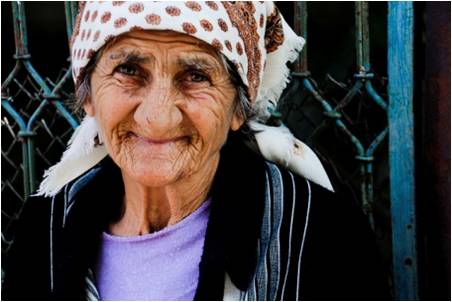 42% of the elderly are at risk of poverty, which means having an income 60% below the country’s national average.[40]
670,000 elder people and children with healthcare problems receiving government assistance.[41] This is a rise from 80,000 Romanians receiving social benefits in 1992. The increase is due to citizens’ heightened awareness of government benefits.
Divorce
5.2 children per 1,000 are affected by the divorce of their parents. Where the divorce rate is declining in other European countries, it is rising in Romania. This is partially because marriage is still commonly practiced.
Those with Disabilities and Mental Illnesses
EU funding of at least 24 million euros is propping up 50 residential institutions in Romania. Thousands of people with disabilities were being ‘warehoused’ in such institutions, segregated from society and subjected to inhumane conditions.[42]
Today, the majority of children with disabilities (over 95%) do not live in state institutions. Still, the lack of school participation for children with disabilities is seven times higher than other children.
There have also been reports that some personnel in state institutions mistreated abandoned children with physical disabilities and subjected children in state orphanages to lengthy incarceration as punishment for misbehavior.
HIV/AIDS
HIV/AIDS wrought devastation in Romania in the 1980s and 1990s. The victims were mostly small children infected in hospitals. Poor sterilization facilities and dubious medical practices, such as infected blood transfusions, were largely to blame. Those that did not die were often ostracized, and many were abandoned. Antiretroviral treatment is free and available to those who need it. Death rates have plummeted. In fact, Romania is now often cited as an example to other poor countries with major HIV/AIDS problems.
Yet a substantial number of Romanians with HIV still don’t know it. The generation infected in the 1980s and 1990s is now at reproductive age, and new cases are still appearing across the country, often years after infection. Health workers say sexual transmission is now the most common method.
According to official statistics, 11, 581 patients diagnosed with HIV and AIDS were registered as of December, with 741 new cases reported between January and December. Societal discrimination against persons with HIV/AIDS occurred, and many persons with the disease dropped out of school due to stigmatization, discrimination, or disease. In December, on International HIV Day, the National Union of Organizations of Persons with HIV/AIDS launched a campaign to increase awareness of HIV infection.[43]
Medical Care
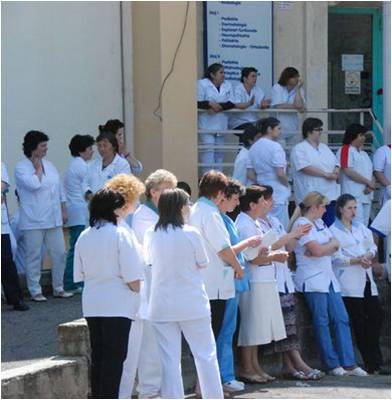 Romania spends just 5 percent of its gross domestic product on health care, about half the percentage of GDP Western European countries spend. 30% of medical professionals, about 10,000 people, have migrated out of Romania in order to work for better pay in western countries.[44]
Only those with employment or who pay for health insurance have access to doctors. Medical care is supposed to be free for children. However, the children are often sent to the pharmacies to buy the necessary medication. Bribes across Romania accounted for $1 million a day in 2005, according to a World Bank report; more recent estimates are not available.
Although the infant mortality rate decreased from 26.9 in 2990 to 9 deaths per 1000 in 2012, it is still high – the highest in the EU and twice as high as the EU average. Romania also continues to suffer from transmittable diseases that can be prevented by vaccines. Tuberculosis is six times higher than the EU average, with Romania representing 25% of all TB cases in Europe – 15% of which are children.
Roma
Eight percent of Romanian children live in absolute poverty, compared to 35 percent among Roma children. 40% of Romani children are undernourished.[45] 75 percent of Roma children do not complete the 8th grade. Roma children are significantly behind in education compared to non-Roma.[46] Romani children were effectively segregated from non-Romani students and subject to discriminatory treatment.[47]
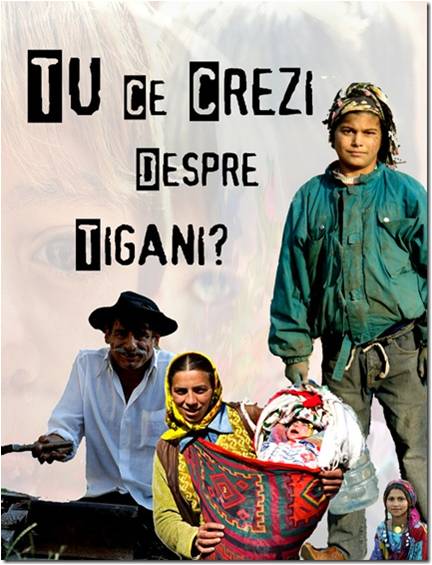 Discrimination against Roma continued to be a major problem. Romani groups complained that police brutality, including beatings, and harassment were routine. Both domestic and international media and observers widely reported societal discrimination against Roma. Major human rights problems included police and gendarme mistreatment and harassment of detainees and Roma, including the death of three Roma at the hands of police and gendarmes.[48]
Observers estimated that there were between 1.8 and 2.5 million Roma in the country, constituting approximately 10 percent of the total population. However, the preliminary results of the most recent official census, taken in fall 2011, counted 619,000 Roma, or 3.2 percent of the population.
Stereotypes and discriminatory language regarding Roma were widespread. Journalists and several senior government officials made statements that were viewed as discriminatory by members of the Romani community; the CNCD fined some individuals as a result. Anti-Roma banners, chants, and songs, particularly at large televised sporting events, were prevalent and widespread.[49]
Romani communities were largely excluded from administrative and legal systems. According to surveys in 2007 and 2008, the latest data available on this matter, between 1.9 and 6 percent of Roma lacked identity cards, compared to 1.5 percent of non-Roma. The lack of identity documents excluded Roma from participating in elections, receiving social benefits, accessing health insurance, securing property documents, and participating in the labor market. Roma were disproportionately unemployed or underemployed.
The legal age of marriage is 18, although girls as young as 15 may legally marry in certain circumstances. Illegal child marriage was reportedly common within certain social groups, particularly the Roma. There were no public policies to prevent child marriages or government institutions that dealt with the problem.
Footnotes:
[1] Some of the statistics are up to two years old as not all statistics are measured annually.
[2]http://cpi.transparency.org/cpi2013/results/
[3]http://www.digitaljournal.com/article/363834#ixzz2suyzlZgf
[4] http://www.state.gov/r/pa/ei/bgn/35722.htm
[5]http://epp.eurostat.ec.europa.eu/cache/ITY_PUBLIC/2-13122012-AP/EN/2-13122012-AP-EN.PDF
[6]http://country.eiu.com/romania
[7]http://www.bloomberg.com/news/2014-05-16/s-p-upgrades-romania-to-investment-grade-after-six-years.html
[8]http://countryeconomy.com/unemployment/romania
[9]http://www.ziare.com/economie/buget/munca-la-negru-in-romania-statul-pierde-18-miliarde-de-euro-pe-an-1166672
[10]http://www.gandul.info/financiar/miliardarul-lakshmi-mittal-la-negocieri-cu-ponta-si-basescu-miza-uriasa-a-discutiilor-de-la-bucuresti-10882299
[12]http://www.neurope.eu/article/eib-provides-loan-rural-development-romania
[13] http://documents.worldbank.org/curated/en/2011/11/15515952/romania-country-partnership-strategy-progress-report-period-fy2009-13
[14]The Adevarul newspaper
[15]Eurostat
[16] Eurostat 28
[17] Behr, Kiss the Hand that You Cannot Bite, xiii.
[18]http://www.insse.ro/cms/files/publicatii/Romania%20in%20cifre_%202012.pdf
[19]http://www.romania-insider.com/world-bank-remittances-sent-by-romanians-abroad-flat-at-usd-3-6-bln-in-2013/107414/
[20]https://uk.news.yahoo.com/fewer-romanian-bulgarian-immigrants-britain-130842089.html
[21] Stracansky, Pavol, “Bringing Up a ‘Lost Generation'”.
[22] http://news.bbc.co.uk/2/hi/3665646.stm
[23] Eurostat 7
[24] Eurostat
[25] xviii UE27
[26] Eurostat footnote 11
[27] https://ro.stiri.yahoo.com/12–dintre-copiii-de-la-%C8%9Bar%C4%83-au-lipsit-de-la-%C8%99coal%C4%83-pentru-a-munci-.html
[28]http://edition.cnn.com/2011/OPINION/02/07/batstone.romania.sex.trade/index.html
[29]http://www.state.gov/documents/organization/192597.pdf
[30] http://anitp.mai.gov.ro/ro/docs/studii/analiza%20victime%202012.pdf
[31]http://tampep.eu/documents/TAMPEP%202009%20European%20Mapping%20Report.pdf
[32] Meghan Collins Sullivan, ‘Painful Lessons from Romania’s Decade-Old Adoption Ban’, Time, March 15, 2013.
[33]http://www.nottingham.ac.uk/iwho/documents/childabandonment/romania/brochure.pdf
[34]http://www.9am.ro/stiri-revista-presei/International/217928/Majoritatea-copiilor-abandonati-in-Europa-Centrala-si-de-Est-sunt-romi.html
[35]http://www.johnstonsarchive.net/policy/abortion/ab-romania.html
[36]http://www.stiriong.ro/ong/servicii-sociale/patriarhul-daniel-predica-din-biserica
[37]http://www.ziare.com/stiri/eveniment/2-400-de-copii-exploatati-prin-munca-au-ajuns-in-grija-salvati-copiii-1021841
[38]http://www.salvaticopiii.ro/upload/p0002000100000002_comunicat_mapa_studiu.pdf
[39]http://www.state.gov/j/drl/rls/hrrpt/humanrightsreport/index.htm#wrapper
[40]http://old.econtext.ro/dosar–2/analiza/pensionarii-romaniei-printre-cei-mai-saraci-din-ue-vezi-cati-pensionari-se-zbat-in-mizerie-in-romania-si-in-celelalte-state-europene.html
[41]http://www.insp.gov.ro/cnepss/wp-content/uploads/2012/03/CNPV.doc
[42]http://www.aljazeera.com/programmes/peopleandpower/2014/04/europe-hidden-shame-2014414124139195247.html
[43]http://www.state.gov/j/drl/rls/hrrpt/humanrightsreport/index.htm#wrapper
[44]http://www.ibtimes.com/medical-leave-romanian-doctors-fleeing-poor-pay-corruption-western-europe-1557178
[45] http://www.copii.ro/Files/2014-02-03_Anexa1_HG_Strategie_protectia_copilului.pdf
[46] http://web.worldbank.org/WBSITE/EXTERNAL/COUNTRIES/ECAEXT/EXTROMA/0,,contentMDK:23208277~pagePK:64168445~piPK:64168309~theSitePK:615987,00.html
[47] http://www.globalpost.com/dispatch/news/afp/130422/unicef-eu-call-further-progress-roma-inclusion-romania
[48]http://www.state.gov/j/drl/rls/hrrpt/humanrightsreport/index.htm#wrapper
[49]http://www.state.gov/j/drl/rls/hrrpt/humanrightsreport/index.htm#wrapper
May Update
Dear Friends,
You have all heard about the foolish man. He built his house on the sand. When the rains poured down and the floods came up, the house fell – and great was its fall (Matt. 7:27)! But what if we modified the story a bit?
First of all, ours is not known as a foolish man. In fact, he has a good reputation, power and wealth. This wealthy man built the faulty house but did not live in it. He lived in the house built on a rock, and he called the poorly constructed house “social housing” and rented it out to the desperately poor. Faced with the massive expense of feeding their children every day and paying for electricity and heat, the disadvantaged renters gave the builder what they had, which was always less than the monthly rent. So, the debt for rent ran up. Then the rains poured down. The waters infiltrated the brick walls, washing away its poor construction. The walls fell. The house was uninhabitable. The poor family moved their possessions out to the streets. Instead of moving the homeless family into other social housing, the wealthy man said that because of their debt, they do not qualify for social housing. Who, in this story, is the foolish person? 
This was more or less the experience of one of the families with whom we are in relationship. The long, hard rains brought down their walls, and they – elderly and children – were evacuated by police wearing black masks. Their furniture and other belongings sit on the street side, covered in cellophane. The city council told them that because of their debt, they don’t qualify for other social housing.
This is one of the injustices that we are currently facing. Another is a situation of abuse. One of the girls involved in our Community Center activities has not been protected by her guardians, leaving her vulnerable to the abuse by other relatives. This is extremely difficult as we try to understand the problem, help to provide a safe environment, and try to involve the appropriate authorities.
Please pray for the injustices that we witness and engage. We need wisdom, courage and tact.
 Although we are going through these trials, we have also experienced some great joys in the last month. We hosted a group made up of friends from Scotland and the Netherlands – relationships that we hope will grow and from which we’ll continue to learn. Our whole community also went on our annual week-long retreat, where we were able to set aside a lot of time for prayer, solitude and reflection and for games and time together. We were glad to have a long-term volunteer and two Servant Team members with us for the retreat. As they departed to the US after the retreat, we welcomed a summer intern and then a small 3-week Discovery Team from George Fox university, which will serve with us in Moldova and then in Romania.
Over the past few months, I’ve also helped facilitate annual evaluations and planning for another Christian non-profit organization in Galati and a soft-ware company run by a good friend of mine. Although this takes a lot of energy and work, I’m delighted to see the betterment of these organizations.
In the coming weeks, we hope to finish our Earth Ship greenhouse and set-up the aquaponics garden. We are also starting to prepare for our summer camp. Although we had our biggest number of kids at camp last year, we hope to bring even more kids this year! That means we are starting now to raise money for this special week away from the normality of life – all the bad and all the good – and experience a week of fun and safety and see a different vision for life. Camp costs $250 per child, so please help us by getting the word out. It really is an investment in a better future for these kids.
We also will be in the US at the end of the summer. As I did last autumn, I am going to try and initiate new partnerships for our community in Romania. If you want to help organize a meeting, presentation or event, please let me know.
Thank you for sustaining us with your encouragement and prayer!
yours in Christ,
david and lenutsa
Visitors

 fragments and reflections