fragments and reflections
Fragments & Reflections
What Kind of a Reader are You?
Oh no, this graphic by Laura E. Kelly is really damning to me and my friends know why:

Does money have eternal life?
 In a chapter entitled `The Jubilee : Time Ceilings for the Growth of Money’, Geiko Muller-Fahrenholz says:
We enjoy time, we are carried along in the flow of time, everything is embedded in its time, so the very idea of exploiting the flow of time to take interest on money lent seemed preposterous. It does so no more because the sacredeness of time has disappeared, even before the sacredness of the land vanished from the memories of our modern societies. Instead capitalist market economies have been elevated to global importance; they are enshrined with the qualities of omnipotence that border on idolatry. So the question arises: does it make sense to attribute to money qualities that no created thing can ever have, namely eternal growth? Every tree must die, every house must one day crumble, every human being must perish.Why should immaterial goods such as capital – and its counterpart, debts – not also have their time? The capital knows no natural barriers to its growth. There is no jubilee to put an end to its accumulative power. And so there is no jubilee to put an end to debts and slavery. Money that feeds on money, with no productive or social obligation, represents a vast flood that threatens even large national economies and drowns small countries…But at the heart of this reregulation is the undisputed concept of the eternal life of money.
Does money have eternal life?
What ideas do we have to embed our economy in time and to appropriate the Jubilee to our capitalist markets?
Simplicity as Acceptance, Challenge and Beauty
We often think of simplicity in terms of minimizing, down-sizing, and reducing what we consume. One of the precepts that we cite regularly are the words of St. Elizabeth Ann Seton: “We live simply so that others may simply live.” But simplicity means much more than this. 
Simplicity is a fundamental acceptance of our human condition. It is the acknowledgment of an existence that is, to use a phrase from the Book of Common Prayer, “earth to earth, ashes to ashes, dust to dust.”
Simplicity is also a confrontational critique and denunciation of the idolatry of wealth. Jesus lovingly said to the wealthy young ruler: “You lack one thing; go, sell what you own, and give the moneyto the poor, and you will have treasure in heaven; then come, follow me” (Mark 10:17-27). These words inspired the Desert Fathers and Mothers and the later monastic tradition to leave everything to pursue God. By practicing simplicity we stand in the long tradition of faithful Christians who recognized the demonic potentialities of possessions and refused complicity with their lure and their lies.
 Simplicity doesn’t only deconstruct wealth; it is also constructive. Simplicity aims to create beauty. We actually find the beauty of simplicity throughout society. It is the beauty of God’s ordered creation, which resonates in us when we experience health, justice, salvation and life.
While beauty is most obvious in art and literature, where the artist pursues aesthetics in symmetry, tone and coordination, it is also evident in sciences. For example, the 2012 Nobel Prize winners in economics are praised for creating something beautiful, as their work results in better patient care and education. Dorothy Wrinch’s molecular theory is called by our contemporaries a “beautiful vision” because it takes the complexities of data and gives a simple explanation. Likewise, in the domain of physics, scientists call Einstein’s theory of relativity “elegant”. 
However, the aesthetic character of simplicity isn’t always easy to see. For example, I have had the opportunity to visit a particular monastery carved out of the hills in Moldova. In the bottom of a cave is a chapel, and at the entrance to the chapel sits an old monk. Most of the time, he sits alone. It is cold. He prays. His austere life looks harsh and unattractive. But it is beautiful for those with eyes to see. The beauty radiates from his wrinkled face in his love, joy and quest for God. Simplicity is seen in the singularity of his desire to seek and love God. 
Simplicity is a spirituality, a way of being in the world, and, as with any healthy lifestyle, it requires discipline and cultivation. Whenever I feel like I’m making some progress in my walk with the Lord, it seems I’m always confronted with something that opens my eyes to new profundity.
This happened on a recent visit to our community in Sierra Leone. I woke up one Sunday morning hurrying to get ready for church. I said a short prayer to ask God for energy for the day and wisdom for the activities before me. Our spirituality is reflected in our prayers. 
We arrived at church and began the singing, clapping and swaying. The sister leading worship shouted a prayer: “Thank you that I am not dead.” I was cut to the quick, challenged and convicted by her prayer of boisterous gratitude, her petition for life in the midst of poverty, and her joy in the immediacy of salvation. It wasn’t that my prayer was bad or wrong, but it limped in its motivation. My prayer was an option, a choice, a luxury. My Sierra Leonean sister’s prayer was a necessity. It was a real prayer for daily bread, for the Father to provide life. For if the God of Life didn’t, who would?
The challenge for me is to move from a spirituality of luxury to a spirituality of simplicity. I am invited to embrace my human condition and be grateful in dependence and need for the Father’s life-giving love and provision. Through the practice of simplicity, we unmask the false promises of wealth for power and security. With singularity of purpose, we seek to know and love God. And, in the midst of the difficult and harsh realities of the world, we practice simplicity that is recognized for its beauty. Following her example of a spirituality of simplicity, we take up the charge of Mother Teresa: “Now let’s do something beautiful for God.”
The Cry Spring 2013
This edition is on our Lifestyle Celebration of Simplicity:
update May 2013
Dear Friends,
In all of our activities, we serve among 60+ kids per week. We serve with the assumption that God is always doing something before we know it. So, we are sensitive to the children and to God’s action in them, trying to avoid any form of manipulation. A few weeks ago during our Saturday kids’ club, Oana told the children about the life of David. She explained David’s failure in committing adultery with Bathsheba and how he killed her husband Uriah. Then, after David repented, God forgave and restored David. At that moment, one of the 11 year old boys said, “Who? Who forgave David?” Oana repeated that God did. The boy gasped with unbelief. Why would God forgive a man who did such bad things? At first, I was struck by the boy’s shock. He has seen some bad things in his young life, but has not lived in a context of grace. And then I was struck by own reaction. I am so accustomed to Bible stories that I am guilty of domesticating God and failing to see how scandalous God’s grace is. Recently, I read the words of Eugene Peterson: “It is hard to see grace because our whole culture is going in the other direction, saying that if you’re smart enough and get the right kind of help, you can solve all your problems.” The Spirit of God in this young boy awakened me anew to the uncommon, hidden and dangerous grace of God.
 I write this update from Lepșa, a village in the Vrancea Mountains, where we hold our annual retreat and summer camp. This week we are meditating on our vision statement: serving Jesus among the most vulnerable. Every morning we have a time of worship and a devotional, followed by 2 hours of solitude. Then we gather to share what God has impressed on us. During our afternoons and evenings, we play games, sleep, celebrate and review some aspects about our ministry like our organizational structure, what we communicate about our ministry, and the five love languages. This year we also celebrated Paul Rase’s 10 years of service with us. It is a joy to have this annual rhythm of withdrawing together to seek God, to enjoy one another, and to be rejuvenated in the midst of nature.
 The retreat has been timely after a busy spring. After 13 years, I again became a Servant Team Coordinator. We had a team of two, which spent two months in Romania followed by two months in Moldova. While they were with me, they helped with the games, art and kids’ club, and we read a number of good books: Rich Christians in an Age of Hunger, How God Became King, The Open Secret, along with other articles. We really enjoyed having a Servant Team again and are praying for someone to be our Short-term Programs Coordinator, so that we can have them more consistently.
 This spring we visited almost all of the evangelical churches in Galati and presented our activities. The children and some of our community members sang some songs. In a few churches, I spoke on Hagar and the vulnerable, Jonah and mission, and foot-washing and intimacy. (The picture on the left was drawn by one of our children as a spoke.)
In March, I led our community in Moldova through a few days of evaluation as they came up with their tactical plan for the coming year. A few weeks later, I returned to Moldova to participate in a conference on Evangelical Mission in an Orthodox Context, where I had the opportunity to present a case study. In April, I led our community in Romania through a tactical planning session. We decided that our major focus for the year is aligning ourselves with our newly formulated mission statement: a better future for vulnerable children through personal  development and by partnerships of friends.
In April, we had two friends, Deb and Krystel, visit us from Lifegate Church in Omaha. Deb led us through teachings and discussions on StrengthsFinders, stress management, geneograms, teambuilding and counseling. Krystel talked to us about breaking generational sin. Both of them did personal counseling with our staff. The few days we had together was a rich investment in our community.
We also had some friends – Frank, John and David – visit us from  England. They finished up some electrical work in the village Day Center, sanded and painted lockers, and installed a ventilation system in our bathroom. After 12 years, we have leaky pipes, broken faucets, rusty shower basins and rotten door frames and need to completely renovate the bathroom. Because the children that come to the Community Center have no hot water and many have no indoor water, this facility is a major support for them. Having the ventilation system finished is a big start. We need to raise about $2,500 to complete the renovation. Please consider helping us with this investment.
In April, I was invited to a consultation on urban mission in a western city in Romania called Cluj. The conversations revolved around the place of the church in the city and the way the church interacts with the city. This exercise forced everyone to think beyond the walls of their own churches and their own programs. Each was able to see their particular congregation in light of the city – its dynamism, its problems, and its needs.
 For Labor Day, we went with the kids to a nearby forest and played games and BBQ-ed. The mother of one of our first-graders is deaf. So, she asked us if she could bring her mom with us. It was a joy to see this lady, who has suffered socially and physically over the years, to be loved and to enjoy herself with us. I was especially encouraged that our first-grader would desire her mom to spend the day with us.
 As with past years, we had a feast for Easter, which took place on May 5th on the Orthodox Calendar. With the children, their families and our staff, we had about 60 people. After the singing and the meal, the kids took turns beating a piñata, which eventually gave up its candy.
Well, that brings you up to date with a busy few months. I will end this letter with another lesson that we learned from the children. Each day the kids have a time of prayer. One of the second-graders, after praying for her family and her day, said to God, “…and Father, take care of yourself too.” We have glimpses into the heart of the Father. We pray that we have eyes to see and ears to hear.
Yours in Christ,
david and lenut(s)a
Pantocrator
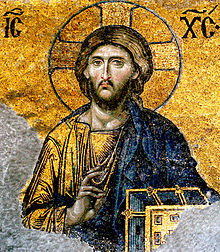 The word Pantocrator is of Greek origin meaning “ruler of all”. Christ Pantocrator is an icon of Christ represented full or half-length and full-faced. He holds the book of the Gospels in his left hand and blesses with his right hand.
The icon portrays Christ as the Righteous Judge and the Lover of Mankind, both at the same time. The Gospel is the book by which we are judged, and the blessing proclaims God’s loving kindness toward us, showing us that he is giving us his forgiveness.
Although ruler of all, Christ is not pictured with a crown or scepter as other kings of this world. The large open eyes look directly into the soul of the viewer. The high curved forehead shows wisdom. The long slender nose is a look of nobility, the small closed mouth, the silence of contemplation.
It is the tradition of the Church to depict “God is with us” by having the large Pantocrator icon inside of the central dome, or ceiling of the church.
Misiunea Urbana
RVE Cluj raportează despre „Iisus în oraș” – o consultatie despre misiunea urbană în Cluj în care am participat:
Consultation on Urban Mission
Last week I participated in an interesting consultation on urban mission in Cluj, Romania. It was organized by PLACE: Partners Learning and Acting in Cities of Europe and the Agnus Media Foundation.
One of the organizers, Robert Calvert, is a minister in the Church of Scotland in Rotterdam. I met him at a similar consultation in Iasi, Romania and at the Lausanne Congress in Cape Town. Another one of the organizers, David Clark, is a minister at the Steeple Church in Dundee, Scotland – a friend and supporter, who has visited us a couple of times in Galati.
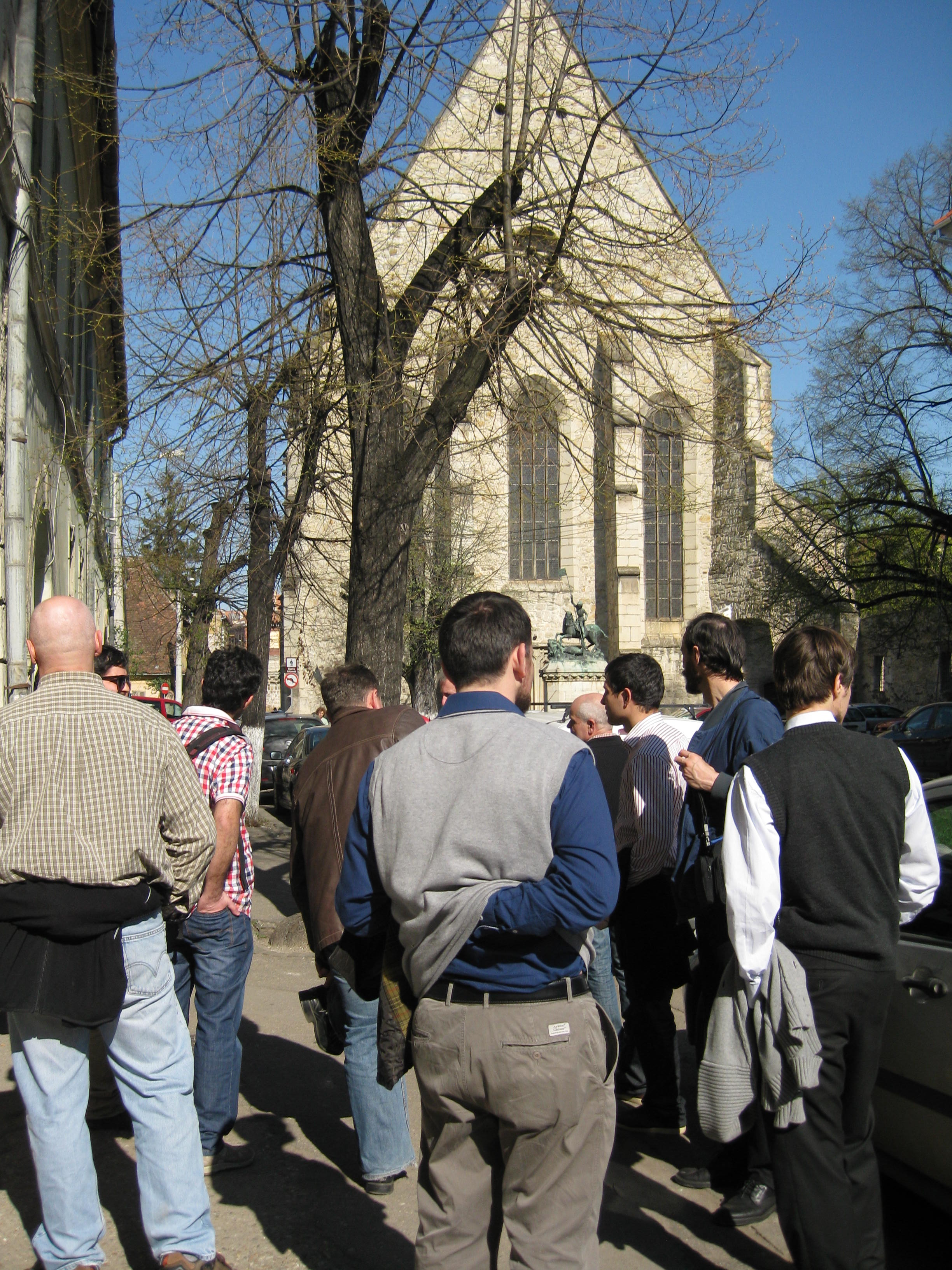 On the first day of the consultation, we did a walking tour of the major churches in Cluj. Because I there were many places on the tour in which I could not see a communist block building, I felt like I was in western Europe, not Romania. I also was surprised by the ecclesial diversity. There is a long history of the Roman Catholic Church going back to the Hapsburg Empire. Through this tradition, the Franciscans and the Jesuits built churches and schools. Cluj was also affected by the Reformation. Lutherans and later Reformed (Calvinists) turned the Roman churches into Protestant ones. Cluj was also one of the places in which the Unitarian church began. It seemed that every decade another one of these groups came to power and changed the churches’ names and evicted everyone else. Of course, the Orthodox Church was also present through the Romanian citizens, though a minority. In order to form a political constituency, Orthodox leaders recognized the authority of the Roman Pope, while keeping their Byzantine liturgy. This church was called Greek Catholic – although it is neither Greek, nor Catholic. In Cluj, the Germans, Hungarians, Romanians and their respective church traditions intersect.
For the rest of the consultation, we sat in a circle and discussed. Sometimes we ate, and then we discussed some more. There were representatives from the Hungarian Reformed Church, the Romanian Orthodox Church, the Greek Catholic Church, the Brethren church, the Pentecostal church, the Baptist church, as well as other independent churches. Most of the participants did not know each other previously. Many of them had not been inside churches other than their own particular tradition. I was delighted to see that there was cordiality and more understanding in the room than disagreements.
The conversations revolved around the place of the church in the city and the way the church interacts with the city. This exercise forced everyone to think beyond the walls of their own churches and their own programs. Each was able to see their particular congregation in light of the city – its dynamism, its problems, and its needs.
We all left knowing that we need to invest in relationships beyond those of our particular tradition and with eyes to envision interaction with and for the urban situation in which we are all ministering.
 On the last afternoon of the consultation, we visited a garbage dump where thousands of Roma have made their homes. Many of them pick through the dump to find recyclables that they can sell. A Christian NGO has helped them build simple, but sturdy homes as well as communal toilets, showers and a kindergarten. We met Salome, a young Swiss girl, who felt God’s call to live among the Roma. So, she got on a train and went. She lives in a simple shelter on the garbage dump and teaches the children in the kindergarten. This was not only inspiring and faith-building, but it was also a great example of the church responding to the city.
Visitors

 fragments and reflections