 Elena Parapiru a scris un articol in Viata Libera entitluat ‘Cersetorie si obscenitati‘. As intreba-o pe d-na Parapiru ce este mai “obscen”: comportamentului cersetorilor sau reactia noastra fata de ei? In loc sa afle numele si povestea celor care cersesc, e suficient doar sa-i dezumanizam? In loc sa raspundem cu compasiune omeneasca, doar ii judecam de sus? In relatarea d-nei Parapiru, cersetorii sunt vinovati si ‘cineva’ trebuie sa-i stranga. Dar care este responsabilitatea noastra sociala? Saracia este obscena. Nepasarea fata de oamenii saraci este obscena. Mai obscena este educatia pe care o dam copiilor nostri: in loc sa-i invatam mila, ii invatam dispret. Poate daca am cauta sa vadem umanitatea celor care sufera la semafoare, am descoperi propria noastra umanitate.
45.425720
28.031044
The Galati newspaper Viata Libera (Free Life) published an article this week called ‘Begging and Obscenities at the Traffic Light.’ The author, Elena Parapiru, describes the offenses of beggars who irritate drivers with their crutches, their intoxication with paint inhalants, their dirtying rather than cleaning windshields, and their public masturbation. She is especially offended because these terrible images are witnessed by her child in the car. Parapiru asks, “Why the hell doesn’t someone roundup those on the streets? Why does my child have to see these terrible images?”
Parapriu’s article is disturbing. However, it’s not so much the horrors that Parapiru describes that disturb me but rather her reaction to them.
Certainly, there is something obscene in public masturbation and in begging. But I would rank them low on the hierarchy of obscenities. How can we complain about public masturbation when every newsstand displays the pornography it sales or when our banks and hypermarkets use sex to sell their services and products? Isn’t the objectification of women more obscene than the public masturbation of an intoxicated beggar?
Perhaps the reality of beggars offends us. But is it their begging us that is an obscenity or is it our complacency and indifference? Shouldn’t we call hunger obscene? Shouldn’t we be offended by the lack of shelter, the lack of education, and the lack of healthy families?
I find Parapiru’s reaction to beggars obscene. I am offended by Parapiru’s disregard, lack of compassion and blaming of the beggars. More than that, I find it high on the hierarchy of obscenities that Parapiru is educating her child in the school of disdain. Parapiru’s child should be offended more by the actions of her mother than by the actions of the beggar.
Rather than expecting ‘someone’ or some government institution to respond to the beggars, I would call on each citizen to respond. At the very least, we can stop and learn the names of the beggars and listen to their stories rather than standing in judgment from afar. Maybe together we can evaluate the complexities of poverty, the history of the impoverished, and practices that can alleviate poverty. But blaming the poor and blaming society’s lack of reaction to the impoverished without taking personal responsibility is cheap and non-constructive.
I would invite Mrs. Parapiru to respond humanely, if not Christianly, by finding ways to truly help beggars find alternative means to survive and work. Perhaps by discovering the humanity in the poor beggars, we can discover humanity in ourselves.
45.425720
28.031044
Q ideas just published an article that I wrote some years back on the Servant Nature of God.
45.425720
28.031044
 Last year I had the opportunity to contribute a chapter to the book Living Mission. It describes an approach to ministry among the poor, marked by incarnation, mission, devotion and community.
If you do read it or have read it, I would love to hear your feedback either on this blog or on the amazon reviews.
45.425720
28.031044
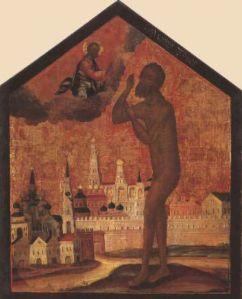 The harshest form of covetousness is not even to give things perishable to those who need them. “But whom do I treat unjustly,” you say, “by keeping what is my own?” Tell me, what is your own? What did you bring into this life? From where did you receive it? It is as if someone were to take the first seat in the theater, then bar everyone else from attending, so that one person alone enjoys what is offered for the benefit of all-this is what the rich do. They first take possession of the common property, and then they keep it as their own because they were the first to take it. But if every man took only what sufficed for his own need, and left the rest to the needy, no one would be rich, no one would be poor, no one would be in need.
Did you not fall naked from the womb? Will you not go back naked to the earth? Where is your present property from? If you think that it came to you by itself, you don’t believe in God, you don’t acknowledge the creator and you are not thankful to Him who gave it to you. But if you agree and confess that you have it from God, tell us the reason why He gave it to you.
Is God unjust, dividing unequally the goods of this life? Why are you rich, while the other is poor? Isn’t it, if for no other reason, so that you can gain a reward for your kindness and faithful stewardship, and for him to be honored with the great virtue of patience? But you, having gathered everything inside the empty bosom of avarice, do you think that you wrong no one, while you rob so many people?
Who is the greedy person? It’s him, who doesn’t content himself with what he has. And who the thief? He who steals what belongs to others. And you think that you are not greedy, and that you do not rob others? What had been granted to you so that you might care for others, you claim for yourself.
He who strips a man of his clothes is to be called a thief. Is not he who, when he is able, fails to clothe the naked, worthy of no other title? The bread which you do not use is the bread of the hungry; the garment hanging in your wardrobe is the garment of him who is naked; the shoes that you do not wear are the shoes of the one who is barefoot; the money that you keep locked away is the money of the poor; the acts of charity that you do not perform are so many injustices that you commit.
45.425720
28.031044
 Over the past few weeks, I blogged about the vast income disparity between the rich and the poor – even within the U.S. – and about the meager aid given by the U.S. One could argue that the burden of the problem lies with the very rich. While this may be true, I don’t understand why someone would be motivated to be generous or philanthropic – someone, that is, who is not a Christian. Christians are called to love, to respond compassionately to the needs of others, and to share what they have with others. This is one of the main mandates Christ gives to his church. So, the important question isn’t “how generous is the U.S.?”, but rather, “how generous is the church?”
The church in America is the wealthiest church in the history of the world. In his book, The Hole in Our Gospel, Richard Stearns tells us that the total income of American churchgoers is $5.2 trillion. It would take just a little over 1% of the income of American Christians to lift the poorest 1 billion in the world out of extreme poverty.
American Christians, who make up about 5 percent of the Church worldwide, control half of global Christian wealth.
If tithing is defined as giving 10 percent or more of one’s pretax income to the church or to nonprofit ministries, only about 5% of American households tithe. The number of those called “born again” Christians in America who tithe is higher: 9%. Of those who call themselves “evangelical Christians,” 24% tithe. That still leaves 76% who are not tithing!
If we are not giving 10%, how much are we giving? The average giving of American church members in 2005 (pre-economic recession) was just 2.58 percent of their income, about 75% less than the oft-promoted 10%. Sadly, as our incomes have increased, our giving has significantly declined. In 1933 at the height of the Great Depression, giving averaged 3.3 percent, 27 percent more than what we gave in 2005.
If we look at where the money goes after it is received by the churches, we find that just about 2% of it goes to overseas missions of any kind. The other 98% stays in the U.S., within our churches and communities.
American Christians, the wealthiest Christians in all history are making to the world is just about 2 percent of 2 percent – actually about five ten-thousandths of our income. That amounts to 6 pennies per person per day that we give through our churches to the rest of the world.
If American Christians gave 10 percent of their incomes instead of the 2.5 percent we currently give, we would have an extra $168 billion to spend in funding the work of the Church worldwide!
45.425720
28.031044
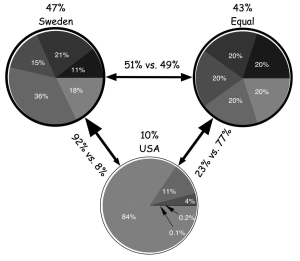
Note. Pie charts depict the percentage of wealth possessed by each quintile; for instance, in the United States, the top wealth quintile owns 84% of the total wealth, the second highest 11%, and so on.
The myth of “trickle-down wealth” is still largely held in the U.S., especially by the right-wing, even though Reagan’s own budget director, who promoted this economic policy in the ‘80s, advocates against it today. A new study on American’s beliefs about the U.S. economy shows that American’s perceptions do not match reality.
The study, facilitated by Michael Norton of the Harvard Business School and Dan Ariely of Duke University, discovered that:
- Respondents dramatically underestimated the current level of wealth inequality.
- Respondents constructed ideal wealth distributions that were far more equitable than even their erroneously low estimates of the actual distribution, believing that the wealthiest quintile held about 59% of the wealth when the actual number is closer to 84%.
- All demographic groups – even those not usually associated with wealth redistribution such as Republicans and the wealthy – desired a more equal distribution of wealth than the status quo.
Respondents were presented with the three pair-wise combinations of these pie charts (in random order) and asked them to choose which nation they would rather join. A large nationally representative sample of Americans seems to prefer to live in a country more like Sweden than like the United States.
Given the consensus among disparate groups on the gap between an ideal distribution of wealth and the actual level of wealth inequality, why don’t more Americans – especially those with low income – advocate for greater redistribution of wealth? First, our results demonstrate that Americans appear to drastically underestimate the current level of wealth inequality, suggesting they may simply be unaware of the gap. Second, just as people have erroneous beliefs about the actual level of wealth inequality, they may also hold overly optimistic beliefs about opportunities for social mobility in the United States
Finally, and more broadly, Americans exhibit a general disconnect between their attitudes towards economic inequality and their self-interest and public policy preferences, suggesting that even given increased awareness of the gap between ideal and actual wealth distributions, Americans may remain unlikely to advocate for policies that would narrow this gap. Hopefully, the same wll not be true of the church.
Before receiving our sabbatical this past year, I had not spent more than three weeks at one time in the U.S. since coming to Romania 10 years ago. While I noticed changes on every visit to the States, there is only so much you can see and sense in such a short time. Having the opportunity to spend an 6 months in the U.S. allowed me to get in tune with the deeper changes in American culture.
One of the most obvious changes that I observed was in the church’s attitude towards the poor. When I lived in the U.S. in the 1990s and was becoming aware of what Scripture said about the poor, I felt like I had to convince friends in the church that responding to the hungry, naked and poor is Christian. It seemed to me that serving the poor was seen as a special call for certain individuals or organizations. It was seen as something secondary to or the means for converting people and growing churches, or it was dismissed altogether as liberal or communist. I was deeply encouraged to see that in the various churches that we visited in different parts of the U.S., “caring for the poor” is part of the church’s regular vocabulary and that it is not seen as optional but an inherent task of the church.
Although this represents a fundamental change in the church’s mentality, I still often heard aggravating statements like this: “Make sure you don’t just care for the poor but that you also lead them to Jesus.” While I agree that Christian ministries among the poor should be explicitly Christian and distinguish themselves from non-Christian social work, the prevalence of statements like this seems to show that the church’s turn towards the poor is superficial or partial. There are a few reasons why this disturbs me.
First, it assumes that because our community includes caring for the physical and social aspects of a person that we exclude spiritual aspects. So, the question itself betrays the inquirer’s modernist compartimentalization of a person – a perspective that is not only non-biblical but anti-biblical. Think of Jesus’ feeding of the multitudes, healing bodies and forgiving sins. These actions, for Jesus, were unified not compartimenalized. Likewise, in our community, we seek to minister holistically.
Second, the very question is dehumanizing to those who are already socially and economically marginalized. The question implies that our friends, who are in need, are the objects of ministry. It assumes that it is all right to help them with their needs as long as you tell them how to be saved. But Scripture doesn’t set up these false dichotomies. Rather, we are called to love. We don’t see the beaten, robbed and dying man on the roadside and give him a tract. We tend his wounds and care for him. Why? Because we love. Likewise, we tell the poor the Good News that God has invaded our world and paved a way to salvation. We don’t do this because that is the goal of our ministry but because we love them. And the authenticity of our love can be tested by whether or not we continue to love even when our message and our God is rejected.
It seems to me that the view that separates Christian proclamation from Christian presence can only be held by those who are isolated from relationship with the needy. I have, for example, painful memories of sitting with young children in coma and dying with AIDS. I could hold their hand. I could sing to them and pray for them. But I could not give them the 4 step plan of salvation. If the church’s message of salvation has any traction at all, it must confront and give hope to those suffering from disabilities, disease and hunger.
Lastly, those that are making these statements, asking me to “remember the disembodied souls,” are not saying to those who focus on teaching, evangelistic campaigns, or other media based forms of church activity, “Make sure you remember the poor” (Galatians 2:10). This reveals a lingering mentality that holds a hierarchy of needs and, thereby, values Christian ministries that claim to tell and teach above those that serve and care. But, if feeding the hungry and thirsty, welcoming the stranger and clothing the naked is an inherent part of Jesus’ gospel, then why don’t demand this from all Christian ministries? Somehow it is accepted that we go around telling people how to get saved from sin without caring for those impoverished by our sinful world. James condemns this behavior flatly saying, “If a brother or sister is naked and lacks daily food, and one of you says to them, ‘Go in peace; keep warm and eat your fill’, and yet you do not supply their bodily needs, what is the good of that? So faith by itself, if it has no works, is dead” (2:14-17).
Although we may moved further into the realization that the church is called to respond to the poor, we still have much further to go.


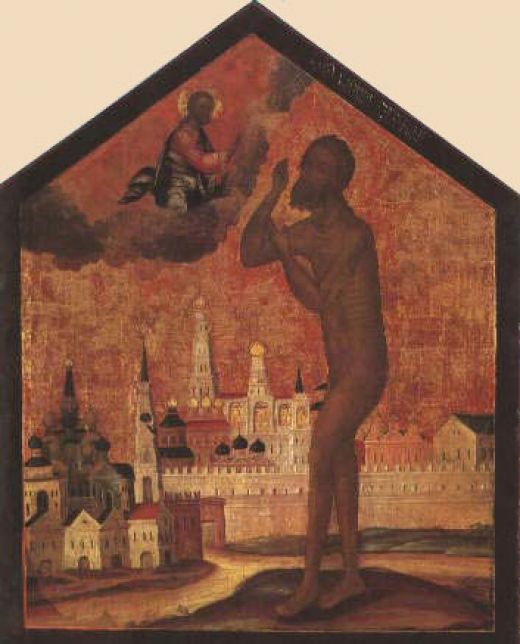 The harshest form of covetousness is not even to give things perishable to those who need them. “But whom do I treat unjustly,” you say, “by keeping what is my own?” Tell me, what is your own? What did you bring into this life? From where did you receive it? It is as if someone were to take the first seat in the theater, then bar everyone else from attending, so that one person alone enjoys what is offered for the benefit of all-this is what the rich do. They first take possession of the common property, and then they keep it as their own because they were the first to take it. But if every man took only what sufficed for his own need, and left the rest to the needy, no one would be rich, no one would be poor, no one would be in need.


 fragments and reflections