fragments and reflections
Uncategorized
Is the Church Responsible for the World’s Poor?
I serve with a Christian international organization that seeks to minister holistically among very need people in 11 countries around the world. While we are not dependent on government funds provided through agencies like USAID, our friends, partner organizations, and many of those suffering from poverty have benefitted from their support. Sadly, with the shuttering of USAID, the infrastructure of support has largely collapsed, leaving needy people even more vulnerable. I also volunteer with a U.S. organization that provides food and material support to elderly, disabled, and other disadvantaged folk in the town we currently live in. Because of government cutbacks in 2025, those we serve are already feeling the pinch. When SNAP (food stamps) is frozen in November, people we know will go hungry.
Those, often with Libertarian leanings, who advocate for “small” government and/or for decreasing progressive income taxes claim that “it has always been the responsibility of individual Christians or the church and not the government to take care of the poor.” While there is some truth in this claim, in what follows, I want to briefly refute it.
Let me begin by noting some examples from the Old Testament that call for the leadership of a nation to care for the poor. We begin with Israel. God calls the leaders of Israel to “seek justice, defend the oppressed, take up the cause of the fatherless, and plead the case of the widow” (Is. 1:17). God judges the leaders for exploiting the poor (Is. 3:13-15; 10:1-4; Mic: 3:1-4; Jer 23:1-2). While different from a modern democratic context, these texts explicitly call for political leadership to protect the poor.
And this mandate is not only for the leaders of Israel. We can glance at a few examples in the Old Testament where the leaders of other nations are called to care for the poor. Egypt serves as a paradigm. Pharoah has exploited the people – particularly the Israelites. God sees their affliction and hears their cries (Ex. 3:7). God comes to deliver the people and judge Pharoah for failing to care. But it is not only the cries of the poor Israelites that God hears. The language is similar in the story of Sodom and Gomorrah. God hears the great outcry from Sodom and Gomorrah and judges the cities (Gen 18:20). With harsh words, Ezekiel compare Sodom to Israel, saying that her sin was pride, gluttony, prosperous ease, and not aiding the poor and needy (Ek. 16:49). We see it again in Jonah where God threatens judgment on Ninevah. Just as in Sodom and in Egypt, the wickedness (i.e. oppression of the poor) of Ninevah comes before God. These are just three incidences in the Old Testament where God judges nations (not only the people of God) for their governments’ lack of care for the poor. What is the implication for us today? Biblical revelation asserts that God calls not only leaders of God’s people to care for the poor, but also leaders of all nations to protect the poor.
Now, let us note the truth in the claim: we do affirm that the Church should care for the poor. Jesus comes to “preach good news to the poor” (Lk 4:14-22). Jesus identifies with the poor and says that we will be judged by how we treat the poor (Mt. 25:31-46). Paul says that the sign of Christian mission is concern for the poor (Gal. 2:10). James says that faith is demonstrated by care for the poor (2:5). I could go on and on. Followers of Jesus should care for the poor.
If this is true, then, was it the job of the Church to care for the world’s poor in the first few centuries? Yes and no. The early church was growing but still small. It could not care for all of society’s poor or do so in societies where there was no church. The early church understood that the tithe (which had been given to the Levites) was to be given to the poor (See Ray Mayhew’s Embezzlement: The Corporate Sin of Contemporary Christianity? and Justo L. González Faith and Wealth). This meant that every Christian (and not only the very rich) could imitate God in generosity toward the needy and encounter God in meeting the needs of the “least of these.” The philanthropic activity of the early church was attested to by their enemies. For example, the emperor Julian the Apostate (331-363 AD) wanted to re-paganize the Roman Empire. Trying to motivate his fellow pagan devotees to care for the poor, he said that the Galileans (aka Christians) “support not only their own poor but ours as well.” If we are to extrapolate to our contemporary context, we can say that Christians are called to care for the poor and that this is what early Christians were known for. The generosity of the early Christians was evangelistic, drawing many to the church (see Rodney Stark, The Rise of Christianity.) That said, the church did not have the capacity, due to numbers and government opposition, to care for all of the poor in their own society, let alone in the world.
What about the Church’s role in caring for the poor after Constantine? In the Greco-Roman context of the early Church, it was the civic duty of the wealthy to “do good,” which meant caring for the well-being of society, which included the poor – though they were seen as having little or no value on the scale of human beings. According to the historian Peter Brown, as Christianity became the official religion of the Roman Empire, the Bishops (among whom St. Basil is preeminent) were invested with the social significance and resources from the state to care for the poor. Because of the new and immense value that the poor held for the salvation of those who aided them, Brown says that the Bishops “invented the poor” (See Peter Brown Poverty and Leadership in the Later Roman Empire). Looking at the early history of the Church, we can see that they understood their mandate for philanthropy to those in need, created institutional support for the poor, and advocated for government funds to care for the poor through the Church.
With the fall of Christendom, the Church has continued to advocate for government programs that care for the poor. It was Christians that led abolitionist movements (though admittedly in the face of Christian opposition as well), established hospitals, and created shelters and food programs (for example, the Clapham Sect, the Methodists, the Salvation Army, etc.) Christians were also at the forefront of movements for women’s rights, civil rights for marginalized races and ethnicities, hospitality for immigrants, and combating social problems caused by industrialization. Catholic Social Teaching and the “Social Gospel Movement” articulated theologies for governmental responsibility for its society’s most vulnerable members. It was through a Christian framework that universal declarations on human rights were articulated and ratified. Thankfully, we have ample examples of faithful Christian involvement in moving their governments to secure care for the poor.
As Christians, we not only need to articulate the biblical, theological, and historical rationale for calling our governments to care for the poor; we also need to unmask Libertarianism for the idol that it is. Libertarians believe that markets are “natural, spontaneous, self-regulating, efficient, and neutral mechanisms that best enable freedom of choice and the equal distribution of resources” (Bretherton, Christ and the Common Life). By simply looking at the vast disparity of wealth that our society enables, we see that Libertarian beliefs are not true. Furthermore, while resisting the state’s involvement in social justice and welfare provision for all citizens, Libertarians need the state to guarantee property rights. Here is a contradiction of convenience. Those with property seek government involvement to protect their interests but denounce government programs that stand to primarily benefit others.
While Libertarians and those like them believe that it is not the responsibility of governments to care for the poor, followers of Jesus should see it differently. The Bible is rich with stories of God calling to account leaders of nations for their treatment of the poor. Likewise, the history of the Church provides models for the church to direct governments to care for the poor. May our Story and our History inspire us in our care for those suffering in poverty and move us to lobby our government leaders to provide systems of protection for our society’s most vulnerable. We hold to the promise that when we do it to the most needy, we do it to Jesus.
The Ethic of Inefficiency
In 2003, I wrote the reflection below on inefficiency. It seems all the more relevant today as our elected leaders inaugurate a department for efficiency, which is applied subjectively, justifies any cut to programs and staff, and increases power in the hands of a few. This is the article:
“You have the watch, but we have the time.” – an Indian philosopher to a westerner
A few weeks ago I met with a Romanian pastor who had spent a year studying in the United States. He couldn’t believe how efficient Americans are, even down to calculating the time of arrival over long distances. His impression was only positive, commenting on how much more we can get done in a shorter amount of time. The more we discussed it, the more I realized how great a value we place on efficiency.
Efficiency is being economical in the use of resources like goods, money and time. For example, consider how we apply our business lingo to “time”, which we save, spend, manage and invest.
But to be efficient is costly. It means we invest in an infrastructure to serve efficiency, which demands maintenance. The most efficient economies consume the most resources. That is why many of us spend much of our lives working to be efficient to accomplish more with less but actually have less and less time for people. In a very real way, friendships, marriages and families are being sacrificed at the altar of efficiency.
Unfortunately, efficiency has been baptized by the church; and what is sanctified is easily justified. A potent illustration is the Christian’s library which includes booklets on the habits of efficient people right alongside other discipleship material, or other literature informed more by the modern business culture than by biblical exegesis.
Naturally, our ministries also reflect efficiency as well-oiled programs that accomplish their goals. But where are the people? Are they well-managed problems? Are they resources to be saved, spent or invested? Or are they persons – each a mystery that demands individual time, care and attention?
I am not saying that efficiency is of no value; I am simply saying that we need to prioritize our values. In his Confessions, St. Augustine said:
“You listen to the groans of the prisoners and free us from the chains which we have forged for ourselves. This You do for us unless we toss our heads against you in the illusion of liberty and in our greed for gain, at the risk of losing all, love our own good better than You Yourself, who are the common good of all.”
Under the illusion of liberty and in greed for more, we lose God. We do not pray because it is not efficient. We do not contemplate; we do not walk; we do not sit and talk. I am afraid that we have overvalued efficiency so that we, like the priest and the Levite, do not have the time to see the poor in the gutter, who is begging us to be a neighbor.
I think a vital problem is that hiding behind our efforts for efficiency lays our desire to dominate. A Romanian priest and theologian, Dumitru Staniloae, poignantly said:
“We can never secure our own freedom by dominating…Wanting to be lord over himself, man then finds that he is subject to himself; similarly, in his relationship with nature, wanting to lord it over the natural world he becomes its slave. Certainly man must be over nature, but that is a very different thing from the passionate desire to dominate it; man is lord of nature indeed only when he is free in relation to it.”
In order for efficiency to retain its value, we must be freed from our passions to dominate. This is something I personally wrestle with. As our ministry has grown, I have been increasingly loaded down with administrative jobs. In order to be efficient, I try to manage my time better so that I have time to accomplish my responsibilities. But I also see in myself the desire to control so that I can accomplish my will and my plans. This is domination in the name of efficiency.
This is vivid in the story of the sinful woman who washes Jesus’ feet with expensive perfume. The wise managers of money thought, “What a waste. Do you know how much we could do if we managed that perfume?” Hidden behind their thoughts of “efficiency” was their will to dominate. But Jesus validated her “waste” as being effective ministry to Him.
What we do is often wasted because we don’t waste it at the feet of Jesus. How often do we disobey in the name of good stewardship? Where are we being positively inefficient? What are we wasting at the feet of Jesus? A good way to verify our motivations for efficiency is to ask, how much time did I spend with people this week? How much time did I spend among the poor? What is the quality of my friendships with the poor? This is a gift offered by the poor: The dominated can reveal and check our tendency to dominate.
Christian Universal Salvation as a Better Motivation for Evangelism
- Introduction: A Christian Universalistic Motivation for Evangelism
Evangelism is the announcement about God, God’s reign, and God’s salvation provided through Jesus Christ. Many believe that God’s salvation is limited because not all hear the gospel before they die or because not all accept the gospel. A dominant view holds that those who are not saved are condemned to eternal hell. Therefore, a major motivation for evangelism is to give persuasive opportunities for people to respond with faith and to be assured of eternal life. Conversely – and no less motivational for evangelism – those who are unable to respond or who reject the gospel are eternally lost in hell. James Packer, for example, says, “people without Christ are lost, and going to hell…And we who are Christ’s are sent to tell them of the One – the only One – who can save them from perishing…If [their need is urgent], does that not make evangelism a matter of urgency for us?”[1] In a similar vein, another Christian scholar claims that the doctrine of hell is the foundation for the church’s morality, spirituality, and mission.[2] Christians, with this view, hold eternal suffering in hell as a necessary motivation for evangelizing the lost.
There is, however, a minority of Christians who believe that, in the end, all will be saved. One such perspective has been recently articulated by David Bentley Hart. Basing his view on biblical exegesis, readings of Christian theological traditions, and metaphysical coherence, Hart argues for universal salvation through Christ, which he frames around issues of justice (the moral consistency of God and the analogous relationship between divine and human notions of the “good”), freedom (which is God’s gift and yet compromised in this life), and personhood (in which every human being exists only in relationship to all humanity).[3] In this paper I take up Hart’s argument in three parts – justice, freedom, and personhood – and contend that it is a better motivation for evangelism.
II. Justice
Any discussion about the eternal destiny of humanity is based on understandings of justice, which presupposes notions of morality, merit, and punishment. One prominent evangelical, Timothy Keller, explains hell and eternal life based on God’s justice, which he tries to hold together with God’s love. He affirms that in Christianity, “God is both a God of love and of justice.”[4] Because God loves creation, all that destroys “its peace and integrity” must be judged justly.[5] Keller believes that a high regard for God’s law and justice holds humans responsible for their disobedience – the ultimate consequence being a just sentence to an eternal hell.[6] Hell, for Keller, is not only God’s judgment, but the distorted notions of freedom that lead to a “prison of [a person’s] own self-centeredness.”[7] Justice requires punishment or penalty and for the “‘divine wrath’ against injustice to be appeased.”[8] This appeasement is accomplished by Jesus, in humanity’s place, on the cross. So, for Keller, evangelism is the proclamation of God’s grace – the forgiveness for injustices – that leads someone to “saving faith” through which they are restored to relationship with God for eternity.[9]
While there are convergences in Keller’s and Hart’s views, there is a significant difference in Hart’s understanding of judgment, which he thinks must be proportionate to the misdeed, corrective, and temporal. While there are different theories of justice,[10] the concept can be generally defined as “to each one’s due.”[11] For justice to be meaningful, punishment must be proportionate to the “infraction.” Any notion of penal justice presumes, as Hart affirms, “a due proportion between…intentions, knowledge and powers of the malefactor on one hand, and the objective wickedness of the transgression on the other.”[12] Keller, however, believes that because souls are eternal, the just consequence is that they are affected by their “moral and spiritual errors” forever.[13] Hart counters this idea, saying that “whenever the terms ‘justice’ and ‘eternal punishment’ are set side by side as if they were logically compatible, the boundaries of the rational have been violated.”[14] That is to say, regardless of a soul’s capacity for eternity, no temporal wrongdoing merits eternal suffering.
Furthermore, eternal suffering has the purpose of being punitive, but it is not corrective. For Christians, Hart contends that punishment is practiced as a remedial act and is conducive to moral reform, but it is not purely retributive.[15] Like Keller and those who see hell as necessary for holding humans accountable for their injustices, Hart believes that hell does instate human responsibility, but it does not need to be eternal in order to do so.[16] In this view, “the punishments of the life to come are (as Paul suggested in 1 Corinthians 3) merely the final, purgative completion of [God’s] act of rescue and restoration…”[17] Although harsh, this punishment is the “necessary means for bringing about the ultimate purification of every soul…”[18] Hell is a just response for disobedience that corrects and, ultimately, restores a human person.
That means that when the reformative purpose of the punishment is achieved, the punishment should cease. This has biblical support. There are some scriptural texts that speak of imprisonment or torture, but, importantly, they specify a limited term (Matthew 5:26; 18:34; Luke 12:47-48, 59). On the other hand, there are many texts that indicate universal salvation.[19] That said, there are also a few New Testament texts that refer to “eternal fire” (Matthew 18:6) and “eternal punishment” (Matthew 25:46). Most translations of the New Testament, render the Greek adjective aionios, from these texts, as “eternal” or “everlasting.”[20] However, Hart asserts that aeon, the noun from which the adjective derives, is most properly understood as “age,” a “substantial period of time,” or an “extended interval.”[21] Referencing uses of the term in the Septuagint and classical and Hellenistic Greek literature as well as understandings of early Greek theologians,[22] Hart convincingly asserts that neither the verb nor the adjective “have the intrinsic meaning of ‘eternal.’”[23] Rather, he believes it is best translated as “age,” which in the New Testament is differentiated between “this age” and “the age to come.”[24] So, for example, Hart renders Matthew 25:46 as: “And these will go to the chastening of that Age, but the just to the life of that Age.”[25] Similarly, he translates Matthew 18:6 as: “Now, if your hand or your foot causes you to falter, cut it off and fling it away from you; it is good for you to enter into life crippled or limping rather than, having two hands or two feet, to be cast into the fire of the Age.”[26]
In his critique of Hart, Michael McClymond claims that translating aeon as “of the Age” means losing not only an eternal hell but also eternal life.[27] However, McClymond seems to understand eternity as a static condition of life in which change is impossible for souls. In contrast, Hart believes in the possibility of change in the age to come.[28] Eternity does not fix one to a particular destination. While Hart believes in the existence of hell in the age to come, he understands that it will cease to exist “when all things are subordinated to him…so that God may be all in all (1 Corinthians 15:28).[29]
Besides situating the terminology within a broader context of ancient Greek literature, Hart also points out that the scriptural texts about damnation in the age to come are parabolic or apocalyptic and are, therefore, symbolic.[30] While the historical and cultural distance between the authors and contemporary readers make certitude about the symbols’ referents impossible, they do beg interpretation. This is especially true of the Revelation of John that also contains references to the aeon of future torment, which Hart translates “unto the ages of ages” (Revelation 14:11; 20:10). Miroslav Volf, however, thinks that these images from Revelation are important for securing justice for evildoers. He believes that Christians must understand that the slaughtered Lamb and the Rider on the white horse are one and the same and, as God, he is the only one who can judge justly.[31] Nonetheless, if divine justice is to inform human justice, then they must be analogous. Volf must explain which injustices in this life deserve “eternal exclusion.”[32] When the proportion between the misdeed and the punishment is lost, “the very concept of justice has been rendered entirely vacuous,” as Hart asserts.[33] Although Hart’s view of Revelation is perhaps overly preterist, interpreting it as a text for an early Judaic Christian community and discounting any prophetic messages for the future,[34] he does recognize that the book itself – these texts notwithstanding – concludes with those who are outside being invited to wash their garments, enter through the open gates of the city, and drink from life’s waters.[35] In this way, readings of eternal suffering in the age to come are subverted from within the biblical text in which God makes “all things new” (Revelation 21:5).
Hart’s view of universal salvation provides a vision for justice that renders judgments that are commensurate with the evil done, that holds humanity to account and remedies their disobedient impulses, and that ultimately ends “the lingering effects of a condition of slavery that God has conquered universally in Christ and will ultimately conquer individually in every soul.”[36] This perspective is a better motivation for evangelism for at least five reasons. First, evangelists announce the goodness of God. The seeming injustice of God condemning some to eternal hell does not need to be defended by claiming that God’s perfect wisdom is beyond human intelligibility. The images of a strictly punitive god can be cast aside.[37] Second, human justice corresponds to God’s justice. Not only is God not perceived to be capricious or evil, but evangelists can proclaim God’s justice as grounds for human justice. This means that humans are held responsible for their actions and have a strong impetus for ethical living. Christians are motivated to evangelize so that the experience of hell is limited and avoided. Third, hell is remedial. Evangelists do not only proclaim just judgment for evildoers but also the promised correction and restoration through any punishment.[38] Fourth, because hell is not only temporal but a present experience, Christians are prompted to share good news not only about one’s future destiny but also about their current suffering. The gospel is the way through sin (forgiveness and reconciliation) and out of sin (sanctification and imitatio Christi). This implies also that evangelism does not end after one is converted but, because hell is a pending consequence for disobedience, it is the continuous call to conformity with Christ. Finally, the gospel is the proclamation that God ultimately does not repay humans according to their merits but claims all creatures for God’s self.[39]
III. Freedom
A common understanding about the gospel is that it is a gift to be freely received and not coercively imposed on anyone. Rick Richardson’s statement is typical: “God will not violate our freedom to choose. God wants love or nothing; forced allegiance is not part of God’s will.”[40] Similarly, for Keller, who, although he believes that justification comes through faith alone,[41] thinks that this rests on human choice. Those that do not choose to respond in faith, choose hell.[42] In fact, he defines hell as “one’s freely chosen identity apart from God on a trajectory into infinity.”[43] The permanency of hell, in this view, is proof of God’s absolute commitment to freedom.[44] Contrarily, Hart argues that freedom is the ability to choose that for which one is created, that humanity’s freedom is compromised by sin, and that God determines to work patiently in human beings, bringing them all to freedom.
In contrast to the “libertarian” model of freedom that values agency in terms of choice, the classical Christian tradition, according to Hart, understands freedom as “a being’s power to flourish as what it naturally is, to become ever more fully what it is.”[45] With this understanding, freedom is not the ability to select from various options. Rather, according to Hart, “to be fully free is to be joined to that end for which our natures were originally framed, and for which, in the deepest reaches of our souls, we ceaselessly yearn.”[46] The truly free human being is imaged by Jesus. With “perfect knowledge of the good” and being “perfectly rational,” he, in full freedom, could only choose the good.[47]
Human freedom, however, is compromised.[48] Hart says that “true freedom is contingent upon true knowledge and true sanity of mind. To the very degree that either of these is deficient, freedom is absent.”[49] Because rational freedom is teleological, there must be “a rational cognizance…of what constitutes either the fulfillment or the ruin of a human soul.”[50] When one’s choices lead to a self-damaging end, then the rationale that makes that choice is called into question. Furthermore, that which separates a person from God – the ultimate good telos for which humans are created – “even if it be our own power of choice, is a form of bondage to the irrational.”[51] Freedom is not simply the agency to choose but rather the demonstration that a person chooses well.
Bad choices reveal compromised freedom. Interestingly, Keller cites those suffering from “addictions to drugs, alcohol, gambling, and pornography,” as examples of not those who do not choose God and, therefore, merit unending hell.[52] However, as anyone acquainted with those who suffer from dependency issues knows, addictions reflect a bondage, not a choice. Addictions inhibit freedom. Even when the addicted want to choose to not consume another dose, they are not free to do so, giving stark depiction to the Apostle Paul’s words: “For I do not do the good I wish; instead, the evil I do not wish, this I do” (Romans 7:19).[53] Of course, there are different measures of agency as all humans wrestle in their negotiations with their desires and compulsions for the good. Yet, the claim that humans must respond to the gospel by freely choosing God does not take seriously enough the enslaving effects of sin and fails to recognize the existing limitations to human freedom.[54]
Along with humanity’s compromised volition and clouded rationale that call into question human freedom, God is not, as the free will proponents believe, one option to be chosen from among others.[55] Rather, Hart argues that God is “Being itself, the source and end of all reality, in which all things live and move and have their being (Acts 17:28).”[56] God, in the Christian view, does not exist as a being among other beings. Rather, all of reality, including freedom itself, exists from, in, and toward God.
This leads to the issue of divine determinism. Some justify eternal condemnation by appealing to God’s determination to preserve human freedom.[57] By God’s perfect love and knowledge, some, like Keller, claim that God also determines to save some from hell.[58] Similarly, Packer claims that God will not violate human freedom and yet will sovereignly make them willing to come to Christ by his grace.[59] Although God’s sovereign determination to save some seems to contradict humanity’s responsible agency to choose or reject Christ, Packer calls it an antinomy that is beyond human intelligibility.[60]
However, instead of employing divine sovereignty to explain why only some are saved, Hart affirms divine determinacy to save all. God is not an “external agency” coercing “creature’s intentions to bring them to the end he decrees.”[61] Rather, as creator, God “is already intrinsic to the very structure of reason and desire within the soul.”[62] Inasmuch as humans are free to will anything, it is because God “is making us to do so.”[63] God is both “the source of all action and intentionality” and the “transcendental object of rational desire that elicits every act of mind and will.”[64] For Hart, there is no need to appeal to antinomy. The “divine determinism toward the transcendent Good, then, is precisely what freedom is for a rational nature.”[65] Although freedom is only partial in this life and humans may need to go through hell to be liberated, God will inevitably set every soul free as they all find their home in God.[66]
This view of human freedom as created by God for God, limited, and ultimately guaranteed by God provides a better motivation for evangelism. The gospel declares that humans are created for freedom, but they are not free. This is particularly good news to those who are aware of their bondage or unfreedom. Understanding the limitations of human liberty, evangelists proclaim freedom as a consequence of the gospel, not its prerequisite. God does not absolutize one’s sense of freedom over their created purpose for eternal life with God. The gospel is the truth that brings freedom. Because this loving pursuit may take much time, Christians do not stop living and sharing the gospel after it has been heard.
Also, because human freedom is compromised, human responsibility is qualified. Although those who believe in eternal suffering cannot account for these, diminished rationale or external contingencies that influence behavior constrain human responsibility. Humans are not blameless, but they are not completely to blame.[67] Ultimately, the good news is that God takes it upon God’s self to rescue and liberate humans as they are unable to do this for themselves (John 8:36). Freedom is delivery from hell, which implies ongoing discipleship. On the journey to union with Christ, increasing agency is evidenced by the continuous “choice” for Christ.
Furthermore, because God is the source and goal of freedom, evangelists do not offer God on the marketplace of options for people to choose. Rather, God is at work in all creatures, shaping their desires, and “will drag everyone” to himself (John 12:32).
IV. Personhood
We have looked at justice, which is often viewed as the rapport between divine judgment and individual behavior, and at freedom, which is usually viewed as the individual prerogative to choose or reject God. Most Christians understand that the gospel is addressed to individuals who are saved as individuals. Even when an individualistic approach to evangelism is criticized,[68] it is fully defended as the locus of eschatological judgment. Hart contests this perspective, saying, “It would be possible for us to be saved as individuals only if it were possible for us to be persons as individuals…”[69] Persons, however, “are not self-enclosed individual substances,” but rather “dynamic events of relation to what is other than themselves.”[70] Therefore, humanity “cannot be saved as persons except in and with all other persons.”[71] Personhood, in Hart’s view, is constituted by humanity’s corporate identity, love by and for others, and memory of others.
Humanity is constituted corporately through creation, the fall, and restoration in Christ. Following the exegesis of Genesis by Gregory of Nyssa, Hart sees Adam, the primordial human being, as the “entire pleroma of all human beings in every age.”[72] In Adam, humanity shares a corporate ontology by virtue of their creation. Humanity also experiences together the collective effects of the Fall. Because of Adam, all humanity is infected with sin.[73] Humanity is “bound in disobedience” and experiences “shared brokenness” in the fallen world.[74] Paul says that all humanity experiences the fall so that God might show mercy to all (Romans 11:32). Just as humanity is created as an “indivisible solidarity” according to the image of God, humanity is recapitulated through Christ.[75] Because “the human totality is a living unity,” God enters “the plenitude of humanity as a single man…assuming humanity’s creaturely finitude and history as his own.” [76] “Reorienting humanity toward its true end…the incarnation of the Logos is of effect for the whole.”[77] This means that God is not simply making a way of salvation for individuals but for the whole fabric of humanity. “Each person is a body within the body of humanity, which exists in its proper nature only as the body of Christ.”[78] Thus, the resurrection is more than the reconstitution of individual corporality; it is “more crucially about the fully restored existence of the persons as socially, communally, corporately constituted.”[79]
That said, individuality is not dissolved in corporate humanity. Hart reiterates that “Christ’s assumption and final recapitulation of the human cannot simply be imposed upon the race as a whole, but must effect conversion of each soul within itself, so that room is truly made for God ‘in all.’”[80]
Humanity’s corporate identity is personally experienced through love and memory. No soul exists in isolation.[81] Each soul is “created by and sustained within the loves and associations and affinities that shape [them].”[82] Humans are attached to the ones they love not only by proximity but also across geography and generations.[83] Humans are “creatures of their loves” and “belong, of necessity, to an indissoluble coinherence of souls.”[84] Thus, in Hart’s view, there can be no eternal bliss for any individual soul without the eternal bliss for all of those who they love.[85] If one is suffering hell, then all those who love them cannot experience heaven.
Of course, some believe that redeemed persons can enjoy the new creation while their loved ones suffer.[86] Some propose that those suffering eternal perdition will be forgotten. Miroslav Volf, for example, argues that just as evil ceases to exist in the new creation so there will be no more memories of evil.[87] But does forgetting evil also entail forgetting the evildoer who is consigned to eternal punishment? Volf diplomatically avoids answering the question, referring his readers to the “hopeful universalist” Hans Urs von Balthazar.[88] However, too much hangs in the balance of Volf’s argument for the question to be left unanswered. If forgetting evil is necessary to enjoy eternal bliss, then the evil ones who suffer eternal hell must also be forgotten. Hart calls this “heavenly lobotomy” the decomposition of a person.[89] A parent, for example, is constituted by the relationship with their child. If they must eternally forget their child, a significant aspect of their identity is lost. If people are constituted by their relations to others, then the loss of the memory of others means a diminution of the one who forgets. Hart points out that when the “deepest emotional and personal elements that compose the soul [are] stripped away,” the soul that is saved loses any continuity between the person of this age and the one of the age of the resurrection.[90] Souls that, for the sake of heavenly bliss, must surrender their memories of the ones they love lose their personhood. If this is the case, then how can one call it “salvation?” Thankfully, forgetting or losing those who are loved or forfeiting any from the tapestry of humanity is not required. Through Christ’s obedience unto death, the whole human race is gathered in Christ and moved toward proper subjection until “they are yielded up as one body to the Father” and “God will be all in all.”[91]
This view of personhood constituted through corporate identity, love, and memory is a better motivation for evangelism. First, humanity is not saved as individuals but only together. That means that every person has a vested interest in the salvation of all other persons. Everyone experiences hell in some capacity until all are reconciled. Thus, each must be sharing the gospel so that all can be saved. Second, this proposal provides a strong basis for critiquing individualism and qualifies all individual decisions by their relationships to others. Third, this view roots evangelism in love and the promise of eternal life with each person’s loved ones instead of in fear of eternal perdition or in obligation to a command. Fourth, Christians do not need to forget others but can practice remembering others in prayer and in sharing the gospel.
V. Conclusion
We have summarized Hart’s argument for universal salvation through Christ and identified advantages for galvanizing evangelism. According to Hart, the gospel is the announcement of God’s victory over death, sin, and the rebellious spiritual powers. The Son is sent into the world and “even into the kingdom of death” to liberate “his creatures from slavery to a false and merciless master.”[92] A summons to all humanity, persons experience salvation in a “new and corporate way of life…in the community of love.”[93] The gospel is the joyous proclamation that the lost can and will find their home in God’s kingdom. On the journey home, the purgation of hell is proportionate to the evil done, corrective, temporal, and ultimately vanquished. So, evangelists can stand on God’s goodness, ground calls for justice in divine justice, and call people out of their hells and into the mercy of God. Although human freedom is compromised, it is created by God and ultimately experienced in God. Thus, evangelists declare the evangel, not as a choice, but as the truth that liberates, even if it takes time. The evangelists proclaim the God who is undeterred by human notions of freedom but is committed to delivering all creation to freedom. Because humans are persons who are constituted by a collective ontology through love and memory, they exist only through one another. The evangelist calls all to eternal life, affirming that none can experience it fully until all creation does. This view of universal salvation in Christ serves as a better motivation for evangelizing.
Bibliography
Aristotle. “The Internet Classics Archive | Nicomachean Ethics.” Accessed May 14, 2021. http://classics.mit.edu/Aristotle/nicomachaen.5.v.html.
Bates, Matthew W. Gospel Allegiance: What Faith in Jesus Misses for Salvation in Christ. Grand Rapids, Michigan: Brazos Press, a division of Baker Publishing Group, 2019.
Calvin, John. “The Institutes of Christian Religion.” The Online Library of Liberty (2011): 1137.
Claiborne, Shane. Executing Grace: How the Death Penalty Killed Jesus and Why It’s Killing Us. San Francisco: HarperOne, 2016.
Edwards, Jonathan. “Why Saints in Glory Will Rejoice to See the Torments of the Damned. Stedman and Hutchinson, Eds. 1891. A Library of American Literature: An Anthology in 11 Volumes.” Accessed May 16, 2021. https://www.bartleby.com/400/prose/293.html.
Hart, David Bentley. That All Shall Be Saved: Heaven, Hell, and Universal Salvation. New Haven, CT: Yale University Press, 2019.
———, ed. The New Testament: A Translation. New Haven: Yale University Press, 2017.
———. “Traditio Deformis.” First Things. Accessed May 14, 2021. https://www.firstthings.com/article/2015/05/traditio-deformis.
Jersak, Bradley. A More Christlike God: A More Beautiful Gospel. Place of publication not identified: PLAIN TRUTH MINISTRIES, 2016.
Keller, Timothy. Generous Justice: How God’s Grace Makes Us Just, 2016.
———. The Reason for God: Belief in an Age of Skepticism, 2018.
———. “Preaching Hell In A Tolerant Age.” Sermon Central. Last modified January 30, 2018. Accessed May 1, 2021. https://www.sermoncentral.comhttps://www.sermoncentral.com/pastors-preaching-articles/tim-keller-preaching-hell-in-a-tolerant-age-752.
———. “3 Objections to the Doctrine of Election.” The Gospel Coalition. Accessed May 2, 2021. https://www.thegospelcoalition.org/article/3-objections-to-the-doctrine-of-election/.
Lebacqz, Karen. Six Theories of Justice: Perspectives from Philosophical and Theological Ethics. Minneapolis: Augsburg Pub. House, 1986.
MacDonald, Gregory. The Evangelical Universalist. Eugene, OR: Cascade Books, 2006.
MacIntyre, Alasdair C. After Virtue: A Study in Moral Theory. 2nd ed. Notre Dame, Ind: University of Notre Dame Press, 1984.
McClymond, Michael. “David Bentley Hart’s Lonely, Last Stand for Christian Universalism.” The Gospel Coalition. Accessed May 14, 2021. https://www.thegospelcoalition.org/reviews/shall-saved-universal-christian-universalism-david-bentley-hart/.
Nyssa, Gregory. On the Making of Man. Vol. The Church Fathers. The Complete Ante-Nicene&Nicene and Post-Nicene Church Fathers Collection. 37 Volumes vols. 3 Series. Catholic Way Publishing, Kindle Edition., 2014.
Pachuau, Lalsangkima. “God’s Mission of Salvation: Dimensions and Scope of Salvation.” Presentation ESJ School of World Mission and Evangelism Seminar (Not yet published): 49.
Packer, J. I. Evangelism and the Sovereignty of God. Downers Grove, Ill: IVP Books, 2012.
Rawson, Katie J. Crossing Cultures with Jesus: Sharing Good News with Sensitivity and Grace. Downers Grove, Illinois: IVP Books, an imprint of InterVarsity Press, 2015.
Richardson, Rick. Reimagining Evangelism: Inviting Friends on a Spiritual Journey. Downers Grove, Ill: InterVarsity Press, 2006.
Rutledge, Fleming. The Crucifixion: Understanding the Death of Jesus Christ. Paperback edition. Grand Rapids, Michigan: William B. Eerdmans Publishing Company, 2017.
Stone, Bryan P. Evangelism after Pluralism: The Ethics of Christian Witness. Grand Rapids, Michigan: Baker Academic, a division of Baker Publishing Group, 2018.
Volf, Miroslav. “Exclusion and Embrace: Theological Reflections in the Wake of ‘Ethnic Cleansing.’” Communio viatorum 35, no. 3 (1993): 263–287.
———. The End of Memory: Remembering Rightly in a Violent World. Grand Rapids, Mich: W.B. Eerdmans Pub. Co, 2006.
[1] J. I. Packer, Evangelism and the Sovereignty of God (Downers Grove, Ill: IVP Books, 2012), 97.
[2] Michael McClymond, “David Bentley Hart’s Lonely, Last Stand for Christian Universalism,” The Gospel Coalition, accessed May 14, 2021, https://www.thegospelcoalition.org/reviews/shall-saved-universal-christian-universalism-david-bentley-hart/.
[3] Pachuau states that “those who emphasize God’s universal salvation tend to either disparage the name and role of Jesus in God’s saving act or make too general a point without attending to details…(Lalsangkima Pachuau, “God’s Mission of Salvation: Dimensions and Scope of Salvation,” Presentation ESJ School of World Mission and Evangelism Seminar (Not yet published): 47.) This is not true of Hart’s proposal for universal salvation through Christ.
[4] Timothy Keller, The Reason for God: Belief in an Age of Skepticism, 2018, 75.
[5] Ibid., 76.
[6] Timothy Keller, Generous Justice: How God’s Grace Makes Us Just, 2016, 101; “Preaching Hell In A Tolerant Age,” Sermon Central, last modified January 30, 2018, accessed May 1, 2021, https://www.sermoncentral.comhttps://www.sermoncentral.com/pastors-preaching-articles/tim-keller-preaching-hell-in-a-tolerant-age-752.
[7] Keller, The Reason for God, 82.
[8] Keller, Generous Justice, 100.
[9] Ibid., 139.
[10] See, for example, Alasdair C. MacIntyre, After Virtue: A Study in Moral Theory, 2nd ed. (Notre Dame, Ind: University of Notre Dame Press, 1984); Karen Lebacqz, Six Theories of Justice: Perspectives from Philosophical and Theological Ethics (Minneapolis: Augsburg Pub. House, 1986).
[11] Miroslav Volf, “Exclusion and Embrace: Theological Reflections in the Wake of ‘Ethnic Cleansing,’” Communio viatorum 35, no. 3 (1993): 202; Aristotle, “The Internet Classics Archive | Nicomachean Ethics, (V.3),” accessed May 14, 2021, http://classics.mit.edu/Aristotle/nicomachaen.5.v.html.
[12] David Bentley Hart, That All Shall Be Saved: Heaven, Hell, and Universal Salvation (New Haven, CT: Yale University Press, 2019), 45.
[13] Keller, The Reason for God, 83. Another rationale is held by Calvin who saw the eternal punishment of souls in hell as a means through which God receives glory and God’s honor is vindicated (John Calvin, “The Institutes of Christian Religion,” The Online Library of Liberty (2011): 1137.)
[14] Hart, That All Shall Be Saved, 43.
[15] Ibid., 44. See, for example, Hebrews 12:5-7, 1 Corinthians 5:5, 11:30-32, and 2 Corinthians 2:6-8.
[16] For Hart, hell is not understood as a torture chamber that forces people into salvation. Without specifying the details, Hart believes that it is purgative of sin and corrective of desires. With a similar proposal, MacDonald describes hell as a “post-mortem situation” where people face the terrible consequence of sin and are educated for salvation (Gregory MacDonald, The Evangelical Universalist (Eugene, OR: Cascade Books, 2006), 162).
[17] Hart, That All Shall Be Saved, 165. In the Apostle Paul’s only image of the final judgment, he says, “If the work that someone has built endures, he will receive a reward; If anyone’s work should be burned away, he will suffer loss, yet he shall be saved, though so as by fire” (1 Corinthians 3:14-15).
[18] Ibid. Hart points out that the English word “hell” is often the translation of different New Testament images (Gehenna, Hades, and Tartarus), which effectively conflates the differences and tends to impose contemporary imaginary for hell onto the translations (ibid., 112).
[19] Hart cites Romans 5:18-19; 1 Corinthians 15:22-28; 2 Corinthians 5:14; Romans 11:32; 1 Timothy 2:3- 6; Titus 2:11; 2 Corinthians 5:19; Ephesians 1:9- 10; Colossians 1:27- 28; John 12:32; Hebrews 2:9; John 17:2; John 4:42; John 12:47; 1 John 4:14; 2 Peter 3:9; Matthew 18:14; Philippians 2:9- 11; Colossians 1:19-20; 1 John 2:2; John 3:17; Luke 16:16; 1 Timothy 4:10; 1 Corinthians 15:23-24 (Ibid., 95-105).
[20] Hart, That All Shall Be Saved, 121.
[21] Ibid.
[22] Ibid., 121–125.
[23] Ibid., 123.
[24] Ibid., 126.
[25] David Bentley Hart, ed., The New Testament: A Translation (New Haven: Yale University Press, 2017). Hart notes that the word kolasis, translated by many as “punishment,” mainly connoted “correction” and was distinguished from timoria, which means “retributive punishment,” which is why he renders it as “chastening.”
[26] Ibid.
[27] McClymond, “David Bentley Hart’s Lonely, Last Stand for Christian Universalism.” See, for example, John 3:16.
[28] Although the meaning of 1 Peter 4:6 is contested, it does intimate post-mortem change.
[29] Hart, That All Shall Be Saved, 194–195. (It is important to note that Hart does not subscribe to the Roman Catholic notion of purgatory (ibid., 118).)
[30] Ibid., 106–120. Keller also makes this point: “All descriptions and depictions of heaven and hell in the Bible are symbolic and metaphorical (Reason, 273, note 10).”
[31] Volf, “Exclusion and Embrace,” 297–302. Volf does hold out the possibility for universal salvation (note 8).
[32] Ibid., 297.
[33] Hart, That All Shall Be Saved, 45.
[34] For a Christian universalist interpretation of Revelation, see: MacDonald, The Evangelical Universalist, 106–132.
[35] Hart, That All Shall Be Saved, 108–109.
[36] Ibid., 129.
[37] If humans who are evil know how to give good gifts to our children, then how much more our Father in heaven? (Matthew 7:9-11) and Bradley Jersak, A More Christlike God: A More Beautiful Gospel. (Place of publication not identified: PLAIN TRUTH MINISTRIES, 2016).
[38] This has implications on how societies practice correction or retribution in their penitentiary systems. See: Shane Claiborne, Executing Grace: How the Death Penalty Killed Jesus and Why It’s Killing Us (San Francisco: HarperOne, 2016).
[39] Hart, That All Shall Be Saved, 52.
[40] Rick Richardson, Reimagining Evangelism: Inviting Friends on a Spiritual Journey (Downers Grove, Ill: InterVarsity Press, 2006), 44; Pachuau, “God’s Mission of Salvation: Dimensions and Scope of Salvation,” 39.
[41] Keller, Generous Justice, 101.
[42] Keller, The Reason for God, 80.
[43] Ibid.
[44] Hart, That All Shall Be Saved, 171.
[45] Ibid., 172.
[46] Ibid., 173.
[47] Ibid., 190. Following Maximus the Confessor, Hart states that unlike humans, Christ, who is the “divine Logos” and “of one essence with the Father and Spirit,” did not have a “gnomic” will – a “faculty of deliberation – but only a “natural” will – “the innate and inextinguishable movement of rational volition toward God (ibid., 188-189). Thus, his will is perfectly free to choose only the “Good” and only will of the Father.
[48] See, for example, John 8:34.
[49] Hart, The New Testament, 177.
[50] Ibid., 178.
[51] Ibid., 173.
[52] Keller, The Reason for God, 80.
[53] Hart, The New Testament.
[54] For example, see 1 Corinthians 13:12.
[55] While Hart does not discuss how this view of freedom commodifies faith, Stone does make this connection, critiquing the western church’s cultural accommodation to consumerism. (Bryan P. Stone, Evangelism after Pluralism: The Ethics of Christian Witness (Grand Rapids, Michigan: Baker Academic, a division of Baker Publishing Group, 2018), 94.)
[56] Hart, That All Shall Be Saved, 181.
[57] Others, like Calvin, in fact, assert that God predetermines that some will suffer eternity in hell (Calvin, “The Institutes of Christian Religion, III.23.11.”).
[58] Tim Keller, “3 Objections to the Doctrine of Election,” The Gospel Coalition, accessed May 2, 2021, https://www.thegospelcoalition.org/article/3-objections-to-the-doctrine-of-election/.
[59] Packer, Evangelism and the Sovereignty of God, 111–112. While both Keller and Packer draw on Reformed theology, Packer places more weight on divine choice about human salvation than Keller who emphasizes human choice.
[60] Ibid., 24–29.
[61] Hart, That All Shall Be Saved, 183. Following Nyssa, Hart understands creation within God’s freedom. God does not create or redeem out of any need but rather ex nihilo. Creation out of nothing is revealed in the creation narrative and also in the creation of a child in an old, barren womb, in the creation of a people out of insignificance and slavery, in the resurrection from the dead, and in the recreation of all things. God freely creates and freely recreates all things (Ibid., 68–73. Gregory Nyssa, On the Making of Man, 23, vol. The Church Fathers. The Complete Ante-Nicene & Nicene and Post-Nicene Church Fathers Collection, 37 Volumes vols., 3 Series (Catholic Way Publishing, Kindle Edition., 2014).
[62] Hart, That All Shall Be Saved, 183.
[63] Ibid.
[64] Ibid.
[65] Ibid., 179.
[66] Ibid., 195.
[67] Ibid., 43.
[68] Richardson, Reimagining Evangelism, 55; Katie J. Rawson, Crossing Cultures with Jesus: Sharing Good News with Sensitivity and Grace (Downers Grove, Illinois: IVP Books, an imprint of InterVarsity Press, 2015), 83; Stone, Evangelism after Pluralism, 98. For a critique of the predestination of individuals, see Matthew W. Bates, Gospel Allegiance: What Faith in Jesus Misses for Salvation in Christ (Grand Rapids, Michigan: Brazos Press, a division of Baker Publishing Group, 2019), 136–137.
[69] Hart, The New Testament, 144.
[70] Hart, That All Shall Be Saved, 151.
[71] Ibid., 146.
[72] Ibid., 139; Gregory Nyssa, On the Making of Man, XVI.16 (37 Volumes vols)., 3 Series (Catholic Way Publishing, Kindle Edition., 2014).
[73] David Bentley Hart, “Traditio Deformis,” First Things, accessed May 14, 2021, https://www.firstthings.com/article/2015/05/traditio-deformis. Hart, following the Eastern Church, does not affirm Augustine’s interpretation of genetic guilt based on his Latin translation of Romans 5:12 that “all sinned in Adam.” Rather, Hart follows the Greek text that states that “all sinned because of Adam.”
[74] Hart, That All Shall Be Saved, 145. See, for example, Romans 11:32.
[75] Ibid., 140.
[76] Ibid., 141.
[77] Ibid.
[78] Ibid., 153. Here we may mention a glaring omission from Hart’s proposal. When Hart says, “the body of Christ” or the “community of love” (p. 205), he seems to imply but does not explicitly state that this is the Church. Although he assumes the authority of Scripture, appeals to arguments from Christian tradition, and ultimately understands universal salvation through Christ, he does not mention the church’s place or role in mediating salvation or its message.
[79] Ibid.
[80] Ibid., 143.
[81] Ibid., 149.
[82] Ibid., 153.
[83] Ibid., 154.
[84] Ibid., 152–154.
[85] This is a major problem for the belief in ultimate annihilation of those who do not choose Christ. For an explanation of this view, see: Fleming Rutledge, The Crucifixion: Understanding the Death of Jesus Christ, Paperback edition. (Grand Rapids, Michigan: William B. Eerdmans Publishing Company, 2017), 459–460.
[86] Jonathan Edwards, for example, asserts that the saints in glory will rejoice to see the torments of the damned. According to Edwards, the suffering of the wicked will increase the jubilation of the saints, and, because they love reflects God’s love, they will no longer love the damned (Jonathan Edwards, “Why Saints in Glory Will Rejoice to See the Torments of the Damned. Stedman and Hutchinson, Eds. 1891. A Library of American Literature: An Anthology in 11 Volumes,” accessed May 16, 2021, https://www.bartleby.com/400/prose/293.html).
[87] Miroslav Volf, The End of Memory: Remembering Rightly in a Violent World (Grand Rapids, Mich: W.B. Eerdmans Pub. Co, 2006), 190–191.
[88] Ibid., 180.
[89] Hart, That All Shall Be Saved, 150.
[90] Ibid., 151–152.
[91] Ibid., 142.
[92] Ibid., 205.
[93] Ibid.
Serving Jesus among the Poor OR Serving the Poor in the Name of Jesus
written in 2018
Since its founding, the vision of Word Made Flesh (WMF) has been to serve (or discover) Jesus among the poorest of the poor. While we are more likely today to talk about “our friends” rather than “the poor” or about those experiencing poverty so as to not identify people with their need or exploitation, this vision has been a distinctive of WMF. (Of course, there are other organizations who share this vision – many from whom we continue to learn – but a major distinctive nonetheless.) This vision statement, while still being listed in print and digital literature about WMF, is not always named as the vision of each WMF community. Perhaps this shift is symptomatic of mission drift.
Mission drift is the slow shifting of an organization’s focus and culture, which eventually becomes something different and pursues a mission other than that for which the organization was initially created. While some shifts may be improvements, I would argue that a drift from WMF’s original vision is not. The case for holding on to our initial vision statement is not so that we maintain a strategic differentiation from other mission organizations. Rather, this vision has and continues to be a prophetic stance: every Christian is called in one way or another to serve Jesus among the poor (i.e., Luke 10:25-37; Galatians 2:10).
The fact that not all WMF communities hold to the same vision statement is not the only symptom of our possible mission drift. The reflections that our staff publish in prayer letters, social media posts, and the Cry journal depict fewer narrations about the life of those who are poor, the signs of the Divine revealed through them, and of our discipleship through them. Similarly, our plans and reports may speak of what we are doing for those who are poor, but less about faithful service to Jesus among the poor.
There may be justifiable causes for the drift. Our staff have less interaction with other organizations (be they Catholic, Protestant, or Orthodox) that share our vision. Many former WMF staff would point to those experiences as being inspirational for their vocation. Many of these staff may have left WMF without ensuring that new staff understood WMF’s vision and ethos. We have also subsequently integrated other existing organizations into WMF who do not share WMF’s vision. In fact, many current staff have never visited another WMF community or like-minded organization.
So, it is not an unnatural step to be in locations with extreme need and to structure service in order to alleviate poverty. This tendency is perpetuated by funding that is designated to poverty alleviation and holistic development. Or, where WMF has set up local businesses, it is challenging to focus on our vision when most of our energy is spent trying to keep the business afloat. Thus, the drift is not always a conscious one, and some WMF communities may have experienced little drift while others more. Still, we must recognize the real possibility of drifting from serving Jesus among the poor to serving the poor in the name of Jesus.
Of course, there is something positive to be said for serving the poor in the name of Jesus. For instance, Jesus commends his disciples to give a cup of water to the vulnerable in his name (Matt. 10:42). This, however, is not enough.
There are significant problems with only serving others in the name of Jesus. First, it assumes power. I have something to give, and it feels good to be in the position of giver rather than the one in need. I give it in Jesus’ name. But does not all that I have already belong to Jesus? Am I not also receiving through the one I serve? Am I not also in need of the cup of water and called to bless those through whom Jesus meets my need?
Second, it tends to objectify the poor. By serving the poor in the name of Jesus, I make the poor the beneficiaries of my service. On the other hand, when I serve Jesus among the poor, I increase proximity and minimize distance with those who are poor, and I see myself as one among the poor rather than above or outside their ranks. Jesus and not the poor is the focus of my service, which instills a humility about what we can realistically accomplish for the poor and entrusts all of our actions of service to Jesus who alone can ultimately meet human need.
Third, when we serve the poor in the name of Jesus, our service may quickly become a job or a profession, and we give the poor our work hours. Contrarily, by serving Jesus among the poor, service is a vocation, and it is offered more through our lives than through our job descriptions.
What is worse than the problems mentioned here is the loss of all that the vision promises. While the oft-cited text from Matthew 25 about serving Jesus in “the least of these” inspires us to loving action, that pericope is first a call to faith. It summons us to faith that Jesus is actually identifying with those in need and rejected. We also act in faith that Jesus receives from us through our meager deeds. What is surprising is that when we walk by faith in serving Jesus among the least, God reveals more of the person of Christ, the character of the kingdom, and the intimacy with the Spirit. This means that I am not only trying to witness to the goodness of God through my act of service to those in need but that I am experiencing the revelation of Christ to me through those in need. I am being discipled and changed through those I’m called to serve among.
This step of faith is not easy. The WMF communities do not idealize those who are poor. In fact, we are profoundly aware of the hurt of those who have experienced rejection, exploitation, and neglect. Many also carry great potential to hurt others. Yet, precisely in these relationships we affirm the image of God in those who have suffered.
On my visit to Romania this past summer, I was reminded of this in my conversations with Loredana*, a young woman who grew up in our Community Center. Loredana has endured great difficulties: witnessing the drowning of her father in the Danube, wrestling with her sexual identity, rape, drug addiction, anxiety… The litany of hurt could go on. Loredana’s son is now part of the Community Center, and Loredana brings him and picks him up every day, demonstrating thoughtful and faithful motherly love. During my afternoons at the Center, we sat on the bench as she reminisced about her past with our community, recognizing how formative it was. She shares with me about how she prays and still sings the songs that she learned with us. Loredana also offers to help with any tasks that need to be done around the Center, finding peace, love, and stability in our presence.
I was struck by the presence of God active in the life of Loredana. While it is deeply encouraging to see the obvious work of the Spirit in Loredana, it is a temptation to identify the image of God in those in whom the signs of God’s work and life are present. Loredana continues to wrestle with anxiety, finds it difficult to be around strangers or to hold down a job. Her sexual identity provokes a reaction, especially in those who do not know her. Yet, the call is to see the image of God in those who are poor – precisely in the brokenness and barrenness and in those moments when one’s behavior is irritating, wrong, or even criminal. In nakedness, imprisonment, hunger – there Jesus says, “Clothe Me, visit Me, feed Me.” Can we see the image of Christ in those with profound and evident needs?
This is the direction in which the initial vision of WMF leads. And this is the gift. When serving Jesus among those who may be dirty, “misbehaving,” carrying parasites, earning money through immoral means, attracted to the “wrong” gender, self-medicating with drugs, and so on, we can begin to see the image of God in ourselves. We realize that it is not our “proper” behavior, our “positive” change, or our “spiritual” practices that form the image of God in us. The image is formed in us by God. We are God’s handiwork. We receive it in faith.
WMF staff continue to serve with great sacrifice in some of the hardest places in the world. Many staff continue to reaffirm their commitments to community and to a lifestyle that goes against the grain of the world. Over the years, Word Made Flesh communities have been bearers of this prophetic message. Perhaps today, however, we need to tune our hearts to hear it again for ourselves: to serve Jesus among those who are suffering from poverty and exploitation.
*Name is changed to protect identity.
An Identity Crisis: Reflections from an International Missions Conference
Recently, I was at an international conference with mission leaders from around the world. I haven’t participated in many international mission conferences. At one of the first of such conferences that I did attend, in 2004, the conference organizers were discussing security measures to protect the mission leaders (largely from the global north) who assumed, in the wake of 9/11, that they could be targets of terrorism and a great loss for the global church. While there was some debate about whether this would be a loss or, in some ways, a gain for the global church, the conference I attended in 2023 had a strikingly different tone. The purpose of this conference was to look at current missional challenges and to think about the future of missions. The question was not “how to protect the mission leaders for the sake of the global church?”, but rather “what is the purpose of the mission leaders in the global church?” As I mentioned, I haven’t participated in many conferences like these, so I am limited in my ability to evaluate them. Yet, it seemed to me that one feature of this conference was a sense of identity crisis.
The crisis revolves around the established role of missionaries (or, if that terminology is too tainted, Christians working cross-culturally for churches and para-church organizations) in the face of major global shifts. Let me outline some of these shifts for missionaries:
- From missions directed by the West to missions directed by the global church and, increasingly, the Majority World church
- From being the center of the missionary narrative to being a part or even a marginal part in the story
- From leadership positions and decision-makers to nodes in a network in which they consult and advise
- From being a ministry leader to being a fundraiser and networker
- From one who takes the gospel to another (receiving) context to being one who supports those taking the gospel to their own context or back to the sending context
These shifts for the missionaries relate to changing desires, capacities, and phenomena in local contexts:
- From foreign leadership and expertise to local leadership
- From wanting people (outsiders) and the power (money, education, networks, etc.) they bring to wanting shared networks, money, and power
- From doing mission that is sensitive to colonialist tendencies to mission by locals in their own context or by locals becoming missionaries and going back to original sending context (often through migration)
- From limited mobility (especially among impoverished countries) to high-speed mobility and globalization (through migration, internet, media, etc.)
- From static contexts to constant change and instability
- From missions in which the church in the global north is involved to a withdrawal of the church in the global north from global missions (evidenced by the decreased number of missionaries; decreased disposable income of the middle class and funding for missions; decreased numbers of Christians in churches; politics of isolation, etc.)
- From language of missionary and missions to language of Christian worker
In light of these shifts, missionaries are asking about their role and about how to relate in different ways. While they are largely supportive of the dismantling of colonialist and paternalistic practices, of sharing power, gifts, and skills, and of the growing identity of the global church and mission from everywhere to everywhere, missionaries are unsure of their role. How do they use their gifts and strengths without imposing, exploiting, or subjugating? How do they relinquish control while also promoting accountability?
While those who are suffering the loss of power, this may seem like an identity crisis. Yet, it appears to be an opportunity for missions. While the relative power of the global north gave power to missionaries from the global north, missionaries are now having to adjust to having less power. Perhaps, the church from the global north was able to accomplish much, missions that ride on the back of political, economic, social, or cultural power normally contribute as much bad as it does good. With less power, missionaries can rediscover missions in the way of the cross, discovering the power of God in weakness. An example of missions in the way of the cross is the posturing of missionaries as bridge-builders, ambassadors, or in-betweeners. Cross-cultural missionaries often feel like misfits – out of place in their new home and never in place in their country of origin. In this out-of-placeness, missionaries can serve as translators of culture and ideas, mediators of difference, and models for engaging otherness. Missionaries can embrace a more marginal posture and serve “from below.” Missionaries can theologically reflect on the shifts, emphasizing coming as well as going, receiving as well as giving. Instead of holding onto projections of what the missionary is, they can hold to a vocation that looks to imitate and reflect the life of Christ.
The Questionable Call to be World-Changers: Reflections on Urbana – Part 3

While naming the overwhelming positives of the Urbana gathering of students, I have also identified some negatives. In my previous post, I discussed the supernatural/natural divide in our metaphysical understanding of reality. Here, I want to discuss the problem in calling students to be “world-changers.”
Again, we must start by recognizing the strong positives in challenging young people to say “yes” to the high call of the Father, to be courageous and even risky, in following the radical path of the Messiah, and to being open to promptings of the Spirit that lead us outside comfort zones and against our cultural tides. Every young person is on a “heroic journey.” Yet, as Christians, the heroic journey goes through the cross and it is never taken alone but in communion with the church.
So, there are some fundamental problems with framing the vocational goal of being a “world-changer.” This was an obvious theme of the Urbana conference and mentioned by various plenary presentations and prayers. At the very least, the concept of “world-changer” needs a lot of caveats; at most, the social script needs to be rewritten. Here are some ways to (re)consider changing the world as Christians:
- While every action (and inaction) may have a ripple effect that results in change, we do not want to put unrealistic expectations on the shoulders of anyone, especially young adults.
- We need to differentiate change. For example, every conversion to Christ – whether it is the first yes or the daily turning to Christ – involves change, which may be cosmic in and of itself. Personal change is different from social, cultural, or ecological change (among others). Where are we looking for change?
- We need a critique of power. Otherwise, our action, in the name of Jesus, may ride the wave of worldly power (that tends to compete and exclude) instead of the way of the cross (which uses power to lift up and care for others). The idea of “world-changer” assumes power. But, in the light of the cross, change may not look like success. How can we contribute to change through weakness or lack of power?
- We need to avoid a messiah complex. Change is not the prerogative of young adults. While we participate in God’s mission and cooperate with God’s actions, change is ultimately initiated and achieved by God. This frees us from believing that change is our burden to carry.
- We need to discuss theories of change so that they do not succumb to western assumptions and formulas (i.e., if I do this, then I will achieve that change…). Instead, our theories of change must all follow the way of the cross, trusting in God’s lifegiving change and the promise of resurrection.
Rather than calling students to be world-changers, can we better draw on biblical imagery:
- Seekers of the kingdom of God;
- Be witnesses of Christ, in imitation of Christ;
- Moving in the presence of Christ to all creation and all peoples;
- Make disciples;
- Remember the poor;
- Live as a holy, royal, priestly people giving an account for the good.
Rather than projecting our visions to change the world, this imagery speaks more to a faithful presence in the world, which is a high and beautiful vocation and one to which young students should be called.
The Supernatural/Natural Divide: Reflections on Urbana – Part 2
While noting in my previous blog post a seeming increased disinterest in global missions, I also named some of the positives of Urbana: ethnic, gender, and even ecumenical diversity; broad envisioning of mission activities and expressions; and gathering, challenging, and discipling students. It really is, in my view, an overwhelmingly positive movement for the church and particularly for university students. Still, there are two negatives that I would like to name: the assumption of a two-tiered supernature/nature cosmos and the framing of disciples as “world-changers.” I’ll start with the first in this blog post.
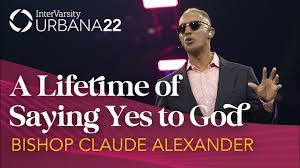
Considering the diversity of speakers and participants at Urbana, I wouldn’t want to make sweeping generalizations. However, one phrase that I heard repeatedly was “supernatural.” Although I heard it from different people in different occasions at the conference, I can reference various sermons from the evening plenary by Bishop Claude Alexander. He uses it in reference to Pentecost and the disciples’ ability to speak in tongues and of God’s empowerment so as to fulfill God’s purpose (see evening plenary 1 minute 10). Alexander explains that the disciples were given a “supernatural ability,” that “God super-met our natural.”
There certainly is an important aspect in distinguishing the Creator (though I wouldn’t call it “supernatural”) from creation (the natural), of receiving from God power to transcend inhibitions, fears, and opposition, and to accomplish what we in ourselves are unable to. That said, the characterization of cosmos in terms of supernatural/natural realms that are disconnected may cohere with the western worldview, but it is at odds with the Christian view.
This view of the supernatural/natural divide is not particular to Intervarsity or Urbana. It is normative in much of western Christianity. It is actually promoted by certain Thomist schools and part of much of Protestant of theology, which holds strongly to a division between (supernatural) grace and nature. Some Protestant missiologists (like Paul Hiebert) have responded to this dichotomy by identifying the “excluded middle” in the western worldview, that sees God and spirits above and humans, creatures, and the earth below, but miss the middle, which most cultures see as the sphere of shamans, priests, and spirits. However, missiologists tend to look at this anthropologically, asking how humans understand the cosmos. For the early church and its theology, it was not just a matter of how a particular culture understands the cosmos but about what is true about the cosmos, reality, and metaphysics. While the discussion can quickly become philosophical and abstract, let me try and describe the dualism and then state as simply as I can what is at stake and why we should resist this supernatural/natural dichotomy.

Eminent theologians like John Milbank, David Bentley Hart, and John Behr have long criticized the supernatural/natural dualism, but Hans Boersma clarified the issues for me. In his book Heavenly Participation, he shows how the early church held a participatory ontology in which all of creation is distinguished from the divine Trinity but exists in, through, and toward the Triune God. The church moved from this metaphysic of ontological participation to one of nominalism and voluntarism in the late Middle Ages. While some discern the seeds for a supernatural/natural dichotomy in Augustine’s thought on predestination (Hart) or in Aquinas, Boersma focuses on Duns Scotus and William of Ockham who moved from the equivocity of being (humans correlate to God by analogy) to univocity (God is one being among beings), from realism (the earthly realities correspond to their heavenly Source and Sustainer) to nominalism (each individual being exists in and of itself) and to voluntarism (in which God’s action is a decision of the will rather than an expression of the Good). While discussions about metaphysics are abstract, they have concrete repercussions. Let me just list some of the consequences of the supernatural/natural dichotomy:
- God and the world are separated (leading to Deism and a distant God). God must come down from heaven. God must intervene in the world. This is in contrast to a participatory ontology in which the world exists in and through God. Whereas the participatory ontology asserts that God’s engagement with creation (i.e., through the incarnation) is a revelation and affirmation of God’s intention, presence, and purpose rather than a supernatural/miraculous intervention.
- God is a being among beings rather than the source of all being. The difference between God and other beings is God’s power (to create, to will as God wills). Rather than holding an analogy of being (analogia entis) in which power is the ability for God to exercise love, truth, and goodness, power is the dominant attribute of God and is exercised arbitrarily and capriciously.
- The salvific value of humans, creatures, and non-creaturely creation is based on God’s will and not on their existential participation in God (in whom we live, move, and have our being). This means that creation holds extrinsic value but not intrinsic value.
- Individual humans no longer exist or participate ontologically in the universal species of humanity but only in their particularity. Thus, we understand salvation as individual rather than corporate and common to all of humanity. This means that there is no ontological investment of one in the salvation of another.
- Because there is no common humanity but only individual humans, there is no ontological sharing of humanity and the ontological connection between, say, the rich and the poor or the Jew and gentile, is broken, leaving only genetic or relational connections.
- The detachment of humanity from ontological participation in God leads to the possibility of seeing them as deprived and then maltreating them.
- If grace is not foundational for being, there has to be a secondary cause (like works, merit, predestination, etc.), which leads to a view of human existence based on merit or God’s arbitrary judgement.
- By conceiving of humans as separate from God rather than existing through God and becoming partakers in the nature of God, access to God can be controlled by the powerful rather than given to all, especially the most vulnerable.
- We lose the metaphysical basis for affirming the Church Creeds (which assume the participatory ontological ideas about being, substance, sharing), and we recite them only in an act of tradition or fideism.
- God and matter are viewed as separate. The created world is “naturalized” and made distinct from God. Creation loses the notion of being a sacrament and is disenchanted (Weber). Matter is no longer enchanted or imbibed with God’s spirit. If nature is just matter and needs the supernatural, then caring for creation is based on human choice and done in relation to human consequence rather than God’s purpose. Thus, the treatment or stewardship of matter belongs to the realm of human action and ethics rather than responsibility to God and God’s authority. (Much too could be said about time, which Charles Taylor responds to in The Secular Age.)
- Viewing matter as “natural” limits our ability to name and engage powers and principalities (are they natural or supernatural?) or interpret the works of the Spirit (are healings, speaking in tongues, fruit of the Spirit natural or supernatural?)
- Human beings are individualized, and the will (and power) becomes a determinative feature of the individual. In terms of mission, this means that a Christian understands this call individualistically and needs to willingly (voluntarily) respond. This can be contrasted to a Christian community’s discernment, sending, supporting, and receiving of those given to God’s mission.
- The response to mission and to those in poverty is through the act of a person’s will and their power, rather than it being a responsibility due to the reality that we share in a common humanity.
When the metaphysics of the early church are recovered and the natural/supernatural dichotomy rejected, we can affirm:
- The interaction between supernatural and natural (divine-human, heaven-earth) is natural.
- “The sole sufficient natural end of all spiritual creatures is the supernatural, and grace is nothing but the necessary liberation of all creatures for their natural ends” (Hart).
- God, in the Son, becomes human (the supernatural for the natural).
- Humans are created for participation in divinity (the natural for the supernatural).
- Mission is participation in what God is doing in the world (“natural”, created, matter) through the Body of Christ by the Spirit.
Reflections on the 2022 Urbana Student Missions Conference – part 1

In between Christmas and New Year’s Eve 2022, I was glad to participate in the Urbana Student Missions Conference for the first time. I had heard the legends about Urbana and had friends participate, and we have had many WMF staff connected through Urbana. My hope was that WMF would make many new contacts with prospective students, to network with other organizations and especially the New Friar organizations, and to learn how university students are thinking about mission.
The conference was a success in many ways. Intervarsity deserves kudos for cultivating diversity. The speakers and worship leaders were of different ethnicities and genders. The participants were also extremely diverse. This manifest diversity has the potential to create a positive ethos for the imagination of the global church and of global mission.
I confess that I personally have a hard time worshiping in spaces that have smoke machines and laser shows. But if it fits anywhere, it fits for young students at Urbana. I participated in the opening evening plenary, which was more emotive than substantive, which led me to skipe the other evening plenaries. I did attend the morning plenaries, which had more substance with speakers from World Vision (Alexia Salvatierra) and IJM, among others. They also began with teaching on prayer practices (silence, breath prayer, etc.), which I enjoyed while perhaps it may have been challenging for the students.
There were many other positives. We were able to discuss study abroad options with the folks from InterVarsity. We were able to spend time with staff from New Friar organizations who share much in common with WMF. We stayed in a community house, hosted by the Englewood church who do inner city work, intentional community, and publish book reviews. And we created connections with other organizations.
A declining interest in global mission?
A disappointment was what I perceived to be a lack of students’ interest in global mission. Previous Urbana conferences had 20,000 participants. This one had 5,500. They also reduced the conference time by a day. I have some theories about this decline. Was the conference so diverse because white students have dropped out? Is the decline representative of the exodus of this generation from evangelical churches? Are other institutions (i.e., Passion, Justice, Southern Baptists, New Room, etc.) organizing their own conferences and drawing students to those instead? Or is there less interest in global mission due to its perceived connection to colonization, to possibly missteps (i.e., When Helping Hurts), to the changing demographics of where the church is in the world (i.e., The Next Christendom), or to students having lower horizons (i.e., focusing on the missional needs of their local community, increased student loan debts, etc.). Most likely, all of these factors, along with wintery weather and a Covid spike, contribute to the diminished interest in mission at this Urbana Conference.
According to Urbana’s accounting, 684 students committed to go on short term mission (less than 1 year); 308 committed to go on midterm mission; and 329 committed to serving more than two years. Interestingly, I would consider anything less than 3 years as being short or perhaps midterm mission as it is only after 3-5 years that one learns language and culture, is established in the location, and begins to make a strong contribution. By calling long-term missions anything more than two years, I think Urbana does a disservice to long-term missions as well as to the students and the expectations they create.

I was curious to learn what the students were thinking. I was able to go to two seminars and tried to listen to the questions students are asking. In my discussion groups, the students were thinking about short-term mission trips or about missions to their university campus or church neighborhoods. The seminar content was on base communities and on wealth and mission. Perhaps those interested in global missions chose to participate in other seminars.
Still, I think a lack of interest in global mission was felt throughout the conference. A sign of the lack of interest was that it seemed to me that few participants spent time in the Connections Hall where we set up our exhibit and tables. I expected that students who self-select and pay for a missions conference would be leaning toward careers in missions. I did speak with students interested in serving in “unreached” locations, in church-planting, and in internships in inner city work. So, there was some interest. However, I spoke with other universities and organizations, and many said that they got few contacts and much fewer than previous Urbana conferences. It seemed to me that there was little foot traffic to the tables. While the position of our table in our shared space with the New Friars may also be a reason for fewer contacts, the overall numbers of contacts of the New Friars was low.
As I departed from the conference, I hypothesized that the students still are interested in engaging in global mission. However, this engagement looks very different. My observation may be specifically about students in the US, but they seem interested in doing mission from where they are at (i.e., being “globally minded”), rather than by going somewhere else. This certainly is a missional posture – albeit different than one that goes, is immersed in a different culture, builds relationships with those of other cultures, and becomes a bridge for the global church. What are the potential gains and possible losses from such a posture?
Fight Like Jesus with Jason Porterfield

We are in the season of Lent, a time in which we rehearse Jesus’ walk to Jerusalem, his suffering, and his death on the cross. Often, we participate in Lent by giving up certain pleasures (i.e., meat, alcohol, chocolate, social media, etc.). Sometimes, believers celebrate by adding something to their daily practices (like silence, generous giving, meditation, etc.) Our Lenten practices help us remember our baptismal vows, lead us to grieve the cost of our sin, and move us to change patterns of behavior. Yet, rarely, does Lent cause us to consider our relationship to violence. Jason Porterfield, in his book Fight Like Jesus, invites us to reflect on peacemaking, especially during Holy Week.
Interestingly, I got to know Jason through his acts of violence. We were at the Urbana conference in December, sharing an exhibition space where we invited university students to consider urban mission among impoverished communities. As I sat at the table, I was frequently bombarded by pieces of candy. After a little investigation, I discovered that I was being pegged by Jason. Was he trying to teach me to fight like Jesus?
In his book, Jason Porterfield walks us through Holy Week, providing insightful biblical commentary, demonstrating Jesus’ intention to bring peace, and raising provocative questions about how we as Christ-followers emulate Jesus’ peace-making way. Jesus reveals practices of peace in the middle of a most violent week.
Palm Sunday: In the midst of waving palm branches and shouting “Hosanna!”, we fail to notice Jesus’ tears. He weeps over Jerusalem for failing to know what would bring it peace. Porterfield discerns Jesus’ lament, amid the crowd’s joy, as an interpretive key for Holy Week. The struggle for peace is understood as the central struggle of Jesus’ march to the cross. Rather than riding the gleeful expectations for a messianic liberator to bring a righteous revolt, Jesus weeps for peace.
Holy Monday: Contrary to popular notions of the cleaning of the temple being violent or spontaneous, Porterfield shows how this was a methodical act, which took time and preparation (i.e., trips to the temple for reconnaissance, making a whip, etc.). The act was not designed or used to harm people, but to purify space meant for the “gentiles” and being used instead for money-changers and the selling of animals for temple sacrifice (in contrast to the Maccabean violent reaction to abuse of the temple). When discussing the temple cleansing, we often overlook the fact that after the money changers and animal sellers went out, the blind and lame came in and were healed (Matthew 21:14). For these marginalized people, their admittance into the temple was just as miraculous as the physical healing they received. Matthew goes on to write that children also entered the temple courts and praised Jesus (21:15). Their presence in the temple is equally astonishing, for, as theologian Stanley Hauerwas notes, “children had always been excluded from the temple” (p. 24).
Holy Tuesday: “Give back to Caesar what is Caesar’s and to God what is God’s.” The listeners realized that Jesus was alluding to the central Jewish tenet that all of humanity is created in God’s image. The implication is this: since the coin has Caesar’s image imprinted on it, give it back to him. Although the coin made claims for pax romana, Jesus intimates that he did not look to the face of Caesar for protection and peace. If everything belongs to God, what’s left for Caesar? What do we owe the Caesars of this world? The logical answer seems to be nothing.
Tuesday also includes the “seven woes to the Pharisees” (woe being a term of grief) and the “little apocalypse” in which Christ-followers are told to flee the immanent war with the Romans rather than defend Palestine. Christlike peacemakers follow Jesus in nonviolent love, speak truth to power and listen with humility when such truth is spoken to them, break the cycle of violence by routinely engaging in small acts of radical love.
Holy Wednesday: This day includes the anointing of Jesus’ feet (as a preparation for burial) by an unnamed women, the prophecy that one man should die for the sake of the nation, and Judas’ actions to betray Jesus. The anonymous women from the margins of society and vulnerable to violence of society, acts in ways that those around her find suspect or of disrepute, but Jesus defends her. Jesus contends for peace on the margins of society. He refuses the mythology that violence is redemptive (that believes that violent means can bring peaceful ends). His efforts to make peace would result in his death, not the death of his enemies.
Maundy Thursday: This is the occasion of the Last Supper or the Passover meal – the breaking and giving of the Messiah’s body, not the enemy’s body; this is where Jesus washes the disciples’ feet; Jesus commands them to love one another as he has loved love. This new mandate is new as it commands us to become a newly formed community, loving like Jesus love and making Jesus known by this love. As violence encroaches and prompts the violent cutting off of an ear, Jesus heals the servant who intends to capture him.
Good Friday: Jesus is before Pilate, representing a kingly challenge to Caesar; proclaiming a kingdom that is not of this world’s violent kingdoms; prompting a choice between Jesus and Barabbas, the violent insurrectionist; and experiencing torture and death on a cross – suffering for the sake of sinners and enemies that breaks the cycle of violence.
Holy Saturday: Jesus is lain in the sealed tomb; later epistles tell us that Jesus descends into Hades, trampling on death with death and setting the captives free.
Easter Sunday: the women visit the tomb and find it empty; the first encounters with the resurrected Jesus, who commissions the disciples to make peace.
We do live in a violent world. Conflicts in central Africa, Myanmar, and Haiti disturb our deepest notions humanity and survival. The communities of Word Made Flesh are intentionally present in places where people are vulnerable to violence, whether that is in poor neighborhoods, helping abused women, or responding to Ukrainian refugees. At times, violence may be a last resort to the threat of violence – and then always regrettable. However, most often, our choice is not between abuse or abuser, victim or victimizer, fight or flight. There are creative choices in the space between. Jason’s book invites us to practice peacemaking, to image loving and helping those who threaten us rather than harming them, to cultivate communities of security rather than sharpening our aim with guns, and to envision a future shared by us and those considered threats and enemies.
While violence is often negative and almost always to be regretted, one thing I do not regret is suffering the attacks of flying candies from the hand of Jason (and perhaps retaliating), getting to know him, and being led by his book to becoming Christians that better resemble the way of our Messiah.
Some Brief Thoughts on the Outpouring at Asbury
With our proximity to Asbury University, many have asked me about what has been happening. Our home is a 3-minute walk to the Asbury University chapel, which I see from my back window. I taught classes at the university last year and am in a doctorate program across the street at Asbury Seminary. Also, Word Made Flesh was founded by Asbury students, and our US office is based in Wilmore. It is surreal to see the cars overrun this two-traffic-light town and to see lines of thousands and thousands of people wrapped around the university, waiting to get into the chapel. For the moment, this is what I will say about the events:

Celebrate the experience of the students. I have heard testimonies of many who struggle with depression or anxiety, with acceptance and isolation, or without having heard God’s voice ever or for a long time. Let’s suspend our evaluations of the event and simply recognize the students’ intense encounters with God as a good in and of itself.
Prioritize the voices of the students. While many are trying to name or explain this movement of God, it began with students, has been led by students, and has been the primary experience of students. So, let’s let them articulate this experience for themselves. Time will come for analysis but let us continue to be sensitive to the students and to listen to them and to what they are hearing from God.
Recognize people’s hunger for God. This past week there was a shift of focus from the AU students to those who are visiting. The long lines in the sun, in the downpouring rain, and in the cold speak of the genuine hunger that people have to encounter God. This too is a good to be celebrated.
Pray for the leaders. The leadership of the university as well as the student leaders have done an excellent job of facilitating this spontaneous movement, maintaining a safe space, limiting access to fringe groups or those who want to coopt the event, focusing on students and young people, and organizing all the volunteers needed to sustain this 24 hour prayer and worship for almost 2 weeks. Hats off to them. They are certainly exhausted, and they are aware of the hard work that will follow.
Expect this to be a beginning and not an end. While some may be coming to witness this movement, hoping for healing, salvation, deliverance, or an experience in the Spirit, what is happening is only a starting point. What follows is discipleship, formation, counseling, the long work of healing and recovery, institutional change, reconciliation, and mission. Students who I’ve spoken with are aware of this and excited for what’s next.
Visitors

 fragments and reflections