fragments and reflections
christianity
Is the Church Responsible for the World’s Poor?
I serve with a Christian international organization that seeks to minister holistically among very need people in 11 countries around the world. While we are not dependent on government funds provided through agencies like USAID, our friends, partner organizations, and many of those suffering from poverty have benefitted from their support. Sadly, with the shuttering of USAID, the infrastructure of support has largely collapsed, leaving needy people even more vulnerable. I also volunteer with a U.S. organization that provides food and material support to elderly, disabled, and other disadvantaged folk in the town we currently live in. Because of government cutbacks in 2025, those we serve are already feeling the pinch. When SNAP (food stamps) is frozen in November, people we know will go hungry.
Those, often with Libertarian leanings, who advocate for “small” government and/or for decreasing progressive income taxes claim that “it has always been the responsibility of individual Christians or the church and not the government to take care of the poor.” While there is some truth in this claim, in what follows, I want to briefly refute it.
Let me begin by noting some examples from the Old Testament that call for the leadership of a nation to care for the poor. We begin with Israel. God calls the leaders of Israel to “seek justice, defend the oppressed, take up the cause of the fatherless, and plead the case of the widow” (Is. 1:17). God judges the leaders for exploiting the poor (Is. 3:13-15; 10:1-4; Mic: 3:1-4; Jer 23:1-2). While different from a modern democratic context, these texts explicitly call for political leadership to protect the poor.
And this mandate is not only for the leaders of Israel. We can glance at a few examples in the Old Testament where the leaders of other nations are called to care for the poor. Egypt serves as a paradigm. Pharoah has exploited the people – particularly the Israelites. God sees their affliction and hears their cries (Ex. 3:7). God comes to deliver the people and judge Pharoah for failing to care. But it is not only the cries of the poor Israelites that God hears. The language is similar in the story of Sodom and Gomorrah. God hears the great outcry from Sodom and Gomorrah and judges the cities (Gen 18:20). With harsh words, Ezekiel compare Sodom to Israel, saying that her sin was pride, gluttony, prosperous ease, and not aiding the poor and needy (Ek. 16:49). We see it again in Jonah where God threatens judgment on Ninevah. Just as in Sodom and in Egypt, the wickedness (i.e. oppression of the poor) of Ninevah comes before God. These are just three incidences in the Old Testament where God judges nations (not only the people of God) for their governments’ lack of care for the poor. What is the implication for us today? Biblical revelation asserts that God calls not only leaders of God’s people to care for the poor, but also leaders of all nations to protect the poor.
Now, let us note the truth in the claim: we do affirm that the Church should care for the poor. Jesus comes to “preach good news to the poor” (Lk 4:14-22). Jesus identifies with the poor and says that we will be judged by how we treat the poor (Mt. 25:31-46). Paul says that the sign of Christian mission is concern for the poor (Gal. 2:10). James says that faith is demonstrated by care for the poor (2:5). I could go on and on. Followers of Jesus should care for the poor.
If this is true, then, was it the job of the Church to care for the world’s poor in the first few centuries? Yes and no. The early church was growing but still small. It could not care for all of society’s poor or do so in societies where there was no church. The early church understood that the tithe (which had been given to the Levites) was to be given to the poor (See Ray Mayhew’s Embezzlement: The Corporate Sin of Contemporary Christianity? and Justo L. González Faith and Wealth). This meant that every Christian (and not only the very rich) could imitate God in generosity toward the needy and encounter God in meeting the needs of the “least of these.” The philanthropic activity of the early church was attested to by their enemies. For example, the emperor Julian the Apostate (331-363 AD) wanted to re-paganize the Roman Empire. Trying to motivate his fellow pagan devotees to care for the poor, he said that the Galileans (aka Christians) “support not only their own poor but ours as well.” If we are to extrapolate to our contemporary context, we can say that Christians are called to care for the poor and that this is what early Christians were known for. The generosity of the early Christians was evangelistic, drawing many to the church (see Rodney Stark, The Rise of Christianity.) That said, the church did not have the capacity, due to numbers and government opposition, to care for all of the poor in their own society, let alone in the world.
What about the Church’s role in caring for the poor after Constantine? In the Greco-Roman context of the early Church, it was the civic duty of the wealthy to “do good,” which meant caring for the well-being of society, which included the poor – though they were seen as having little or no value on the scale of human beings. According to the historian Peter Brown, as Christianity became the official religion of the Roman Empire, the Bishops (among whom St. Basil is preeminent) were invested with the social significance and resources from the state to care for the poor. Because of the new and immense value that the poor held for the salvation of those who aided them, Brown says that the Bishops “invented the poor” (See Peter Brown Poverty and Leadership in the Later Roman Empire). Looking at the early history of the Church, we can see that they understood their mandate for philanthropy to those in need, created institutional support for the poor, and advocated for government funds to care for the poor through the Church.
With the fall of Christendom, the Church has continued to advocate for government programs that care for the poor. It was Christians that led abolitionist movements (though admittedly in the face of Christian opposition as well), established hospitals, and created shelters and food programs (for example, the Clapham Sect, the Methodists, the Salvation Army, etc.) Christians were also at the forefront of movements for women’s rights, civil rights for marginalized races and ethnicities, hospitality for immigrants, and combating social problems caused by industrialization. Catholic Social Teaching and the “Social Gospel Movement” articulated theologies for governmental responsibility for its society’s most vulnerable members. It was through a Christian framework that universal declarations on human rights were articulated and ratified. Thankfully, we have ample examples of faithful Christian involvement in moving their governments to secure care for the poor.
As Christians, we not only need to articulate the biblical, theological, and historical rationale for calling our governments to care for the poor; we also need to unmask Libertarianism for the idol that it is. Libertarians believe that markets are “natural, spontaneous, self-regulating, efficient, and neutral mechanisms that best enable freedom of choice and the equal distribution of resources” (Bretherton, Christ and the Common Life). By simply looking at the vast disparity of wealth that our society enables, we see that Libertarian beliefs are not true. Furthermore, while resisting the state’s involvement in social justice and welfare provision for all citizens, Libertarians need the state to guarantee property rights. Here is a contradiction of convenience. Those with property seek government involvement to protect their interests but denounce government programs that stand to primarily benefit others.
While Libertarians and those like them believe that it is not the responsibility of governments to care for the poor, followers of Jesus should see it differently. The Bible is rich with stories of God calling to account leaders of nations for their treatment of the poor. Likewise, the history of the Church provides models for the church to direct governments to care for the poor. May our Story and our History inspire us in our care for those suffering in poverty and move us to lobby our government leaders to provide systems of protection for our society’s most vulnerable. We hold to the promise that when we do it to the most needy, we do it to Jesus.
The Ethic of Inefficiency
In 2003, I wrote the reflection below on inefficiency. It seems all the more relevant today as our elected leaders inaugurate a department for efficiency, which is applied subjectively, justifies any cut to programs and staff, and increases power in the hands of a few. This is the article:
“You have the watch, but we have the time.” – an Indian philosopher to a westerner
A few weeks ago I met with a Romanian pastor who had spent a year studying in the United States. He couldn’t believe how efficient Americans are, even down to calculating the time of arrival over long distances. His impression was only positive, commenting on how much more we can get done in a shorter amount of time. The more we discussed it, the more I realized how great a value we place on efficiency.
Efficiency is being economical in the use of resources like goods, money and time. For example, consider how we apply our business lingo to “time”, which we save, spend, manage and invest.
But to be efficient is costly. It means we invest in an infrastructure to serve efficiency, which demands maintenance. The most efficient economies consume the most resources. That is why many of us spend much of our lives working to be efficient to accomplish more with less but actually have less and less time for people. In a very real way, friendships, marriages and families are being sacrificed at the altar of efficiency.
Unfortunately, efficiency has been baptized by the church; and what is sanctified is easily justified. A potent illustration is the Christian’s library which includes booklets on the habits of efficient people right alongside other discipleship material, or other literature informed more by the modern business culture than by biblical exegesis.
Naturally, our ministries also reflect efficiency as well-oiled programs that accomplish their goals. But where are the people? Are they well-managed problems? Are they resources to be saved, spent or invested? Or are they persons – each a mystery that demands individual time, care and attention?
I am not saying that efficiency is of no value; I am simply saying that we need to prioritize our values. In his Confessions, St. Augustine said:
“You listen to the groans of the prisoners and free us from the chains which we have forged for ourselves. This You do for us unless we toss our heads against you in the illusion of liberty and in our greed for gain, at the risk of losing all, love our own good better than You Yourself, who are the common good of all.”
Under the illusion of liberty and in greed for more, we lose God. We do not pray because it is not efficient. We do not contemplate; we do not walk; we do not sit and talk. I am afraid that we have overvalued efficiency so that we, like the priest and the Levite, do not have the time to see the poor in the gutter, who is begging us to be a neighbor.
I think a vital problem is that hiding behind our efforts for efficiency lays our desire to dominate. A Romanian priest and theologian, Dumitru Staniloae, poignantly said:
“We can never secure our own freedom by dominating…Wanting to be lord over himself, man then finds that he is subject to himself; similarly, in his relationship with nature, wanting to lord it over the natural world he becomes its slave. Certainly man must be over nature, but that is a very different thing from the passionate desire to dominate it; man is lord of nature indeed only when he is free in relation to it.”
In order for efficiency to retain its value, we must be freed from our passions to dominate. This is something I personally wrestle with. As our ministry has grown, I have been increasingly loaded down with administrative jobs. In order to be efficient, I try to manage my time better so that I have time to accomplish my responsibilities. But I also see in myself the desire to control so that I can accomplish my will and my plans. This is domination in the name of efficiency.
This is vivid in the story of the sinful woman who washes Jesus’ feet with expensive perfume. The wise managers of money thought, “What a waste. Do you know how much we could do if we managed that perfume?” Hidden behind their thoughts of “efficiency” was their will to dominate. But Jesus validated her “waste” as being effective ministry to Him.
What we do is often wasted because we don’t waste it at the feet of Jesus. How often do we disobey in the name of good stewardship? Where are we being positively inefficient? What are we wasting at the feet of Jesus? A good way to verify our motivations for efficiency is to ask, how much time did I spend with people this week? How much time did I spend among the poor? What is the quality of my friendships with the poor? This is a gift offered by the poor: The dominated can reveal and check our tendency to dominate.
A Summary of The Transformation of American Religion – Alan Wolfe
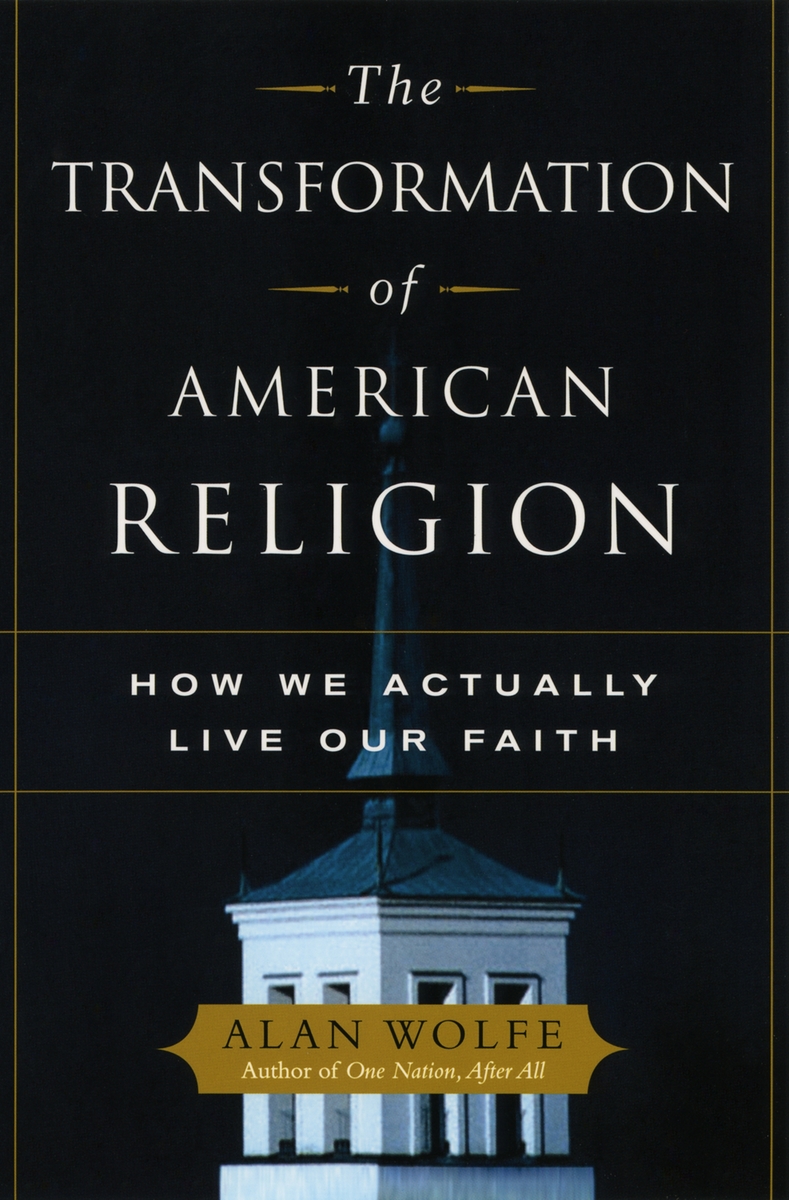
I read it because it is often cited along with James Hunter’s To Change the World, a book on culture to which I refer often.
Where Hunter looks at how the church, in its distinctive liberal, conservative and Anabaptist expressions, tries to change society and culture, Wolfe looks at how culture has changed religion (looking primarily at Jewish, Catholic and Protestant religious communities). As a non-believer and non-theologian, Wolfe’s analysis is of one looking from the outside in.
“Sociologists a few decades ago predicted the decline of religion in modern societies, but in the most modern society of all religion has neither declined nor advanced; it has been transformed.” Hence, Wolfe is sympathetic to religions and aware of their prominent place within American society.
Yet, he affirms, “American popular culture is both amazingly indifferent to those seeking to shape its direction and astonishingly competent at absorbing and transforming anyone who tries.” From the book jacket, it states that “God has met and struggled fiercely against American culture – and the culture has won.”
Wolfe begins with worship, stating that it no longer centers on God but rather on the self: the self’s experience, relationship to the divine, development and general good feelings.
He then looks at fellowship, which he thinks has moved from being denominational to being anti-institutional. The effect is a free-agent moving from denomination to denomination and to non-denominational and para-church gatherings, looking for that which best meets the individual’s needs.
Concerning doctrine, Wolfe says that it is no longer central to faith communities. Doctrine is liberalized, making it more palatable for the surrounding society. Where commitments are made to doctrine, they are mostly superficial and adherents rarely know the rational for the doctrine or are able to engage with countering ideas. Often, there is belief without a specified content of the belief.
Tradition. Conservative religious communities may continue to commit to traditional forms, but the locus of applying tradition is not in the “handing down” but in the “picking up” of what the individual wants and how they want. Generally, traditions succumb to American innovation that seeks to be familiar and welcoming to potential converts.
In his chapter on morality, Wolfe talks about how conservative doctrine marginalizes women. Yet, the actual practice in their faith communities is less misogynistic and more empowering of women. While sexual promiscuity and divorce rates are the same if not higher in religious communities, sexual practices are shaped by the religious communities – although in ways that view sexuality positively (as opposed to Church Fathers like Augustine or Puritan beliefs). That is to say, morality is redefined. Because of its success in adhering to its moral requirements, Wolfe treats the Mormon Church in this chapter, stating that it too may be more influenced by surrounding society as it grows out of its Utah bed. While he is skeptical of calling it causal, Wolfe also mentions religious communities engaging in helping poor communities and the holistic change that occurs in these communities. Finally, Wolfe cites a study in which religious adherents were more honest than their non-religious colleagues (signs of the impact of faith on behavior) and other studies that show that they are just as likely to cheat and more hypocritical (signs of behavior irregardless of faith).
Wolfe surprisingly laments the loss of conceptualizations and vocabulary for sin because he understands the social costs of not naming and aspiring to high ideals of conduct. He sees the crux of the problem shifting from offense to God to the destruction of the human. He sees the loss of sin in its homiletic usage as preachers do not want to sound judgmental but rather positive. He sees the replacement of sin with psychological notions of dysfunction. Thus, response isn’t repentance or penance but rather therapy.
Wolfe goes on to discuss “witness,” by which he means the sharing of one’s faith with non-believers. He notes how conservative Christians have moved from fire and brimstone preaching to the sharing of faith by their lifestyle or by service to others. While there may be increased timidity in the face of society, where there is willingness to share, it is not judgmental. In this way, the evangelist, like a good salesperson, is asking less from the potential convert and offering more. Wolfe also looks at the changing demographics caused by urban sprawl, which make the public spaces, where interaction occurs with potential converts in the city less secure, and greatly reduces space for interaction outside the city. Finally, using the Christian television and music industries as examples, Wolfe describes how in employing the media of the world (i.e. radio, movies, etc.), Christians gain notoriety and finances but loose their Christian identity – what Wolfe calls a Faustian pact.
In his chapter on identity, Wolfe discusses Islam, its ability to preserve the religious identity of its adherents while also changing its religious practices in the American context. Wolfe here also describes how immigrant communities, typically from Asia or Latin America, are conservative and stable, aspects which meet deep needs of volatile migrants. Some convert to Christianity upon arrival in America, describing their new faith as enabling to their becoming good Americans. For second-generation immigrants, conservatism is not as important and many turn to charismatic and para-church expressions of Christianity. Where Islam is being preserved by its immigrant adherents and Christianity discovered, Buddhism is drawing Americans. However, Wolfe describes this as an Americanized Buddhism that is more psychological, more meditative and organized more like churches and that is not wholly condoned or accepted by Buddhist immigrants. Looking at the broad sweep of American identity, Wolfe believes that religion, in light of immigration policy, can no longer be a central and unifying feature of American identity, which raises questions about pluralism, tolerance and social cohesion. (Written in 2003, Wolfe’s optimism for increased religious tolerance, while perhaps true, did not anticipateTrumpian exclusive nationalism.)
Wolfe concludes by advocating for ongoing religious practice in society, albeit with lower expectations as it shifts in conformity to American democracy. Wolfe also chastens liberals who quickly write off religious communities as close-minded and unable to engage intellectual debate, suggesting that they make room for democratic discourse, for their voice and practices, even when they are not agreeable. Pragmatically, Wolfe advises that society give less credence to what believers say (which may be dogmatic and exclusive) and more to what they do (which is typically moderate and more shaped by the surrounding culture than not.)
What Do We Mean by “Evangelism?”
Word Made Flesh presently ministers in nine countries where we live among the poor and long to communicate the Good News of King Jesus and His coming Kingdom. Typically, the term we ascribe to this activity is “evangelism.” But as we minister among the poor, we wrestle with the limitations and follies of our traditional understanding of the concept.
The word “evangelism” often conjures in the contemporary mind images of televangelists, traveling preachers or zealous proselytizers. When we define evangelism, we usually talk about “getting people saved” or “making sure you know where you are going when you die.” Although we do long for people to come to know God and to have eternal security, this view is a narrow and truncated form of biblical evangelism. Such a view creates a gospel that is mere word, void of content. It secularizes and domesticates the gospel, which constrains it to the private realm and withdraws from social and political sin. It turns the gospel into a consumer product by aiming to satisfy the individual’s needs while lacking the commitment to transform humanity. This gross individualism has mutilated our concept of evangelism and fed the atomization of humanity and society.
This faulty understanding, propagated by many American evangelicals, has been successfully exported to evangelical churches around the world. Consequently, when telling our fellow Christians that we evangelize, some think we’re only talking about biblical paper dolls moving across flannel boards or PowerPoint presentations. Worse yet are the unsatisfied frowns we often see when explaining that we do not simply evangelize through our words. Therefore, we want to take this opportunity to reflect on the meaning of biblical evangelism so that our concept and practice of mission may be radicalized.
We must ask ourselves what biblical evangelism is, and how the tradition of the church can correct our currently deviated understanding. The word “evangelism” is derived from the Greek euangelion, “good news, gospel, evangel.” Likewise, “evangelization” means “to announce the good news.” However, since the early 19th century, church and mission circles have changed and increasingly distorted the meaning of the verb “evangelize” and its derivatives (David Bosch, Transforming Mission). In this article, we will attempt to outline an understanding of evangelism as differentiated from contemporary definitions and in line with its original meaning.
Evangelism is often described as the proclamation, presence, persuasion and prevenience of the gospel. Let us outline each of these aspects of evangelism, then look at their implications.
Evangelism is Proclamation
Evangelism is proclamation, but it is not synonymous with verbiage. It is helpful to distinguish between euangelion (gospel) and kerygma, the Greek word that refers to preaching or proclaiming that which is fundamental and all-embracing in the New Testament. Kerygma was the event of being addressed by the word. Some have suggested that there was a particular kerygmatic formula about Jesus—that is, the “language of the facts,” and the facts being that God came in Jesus Christ, was crucified, resurrected and ascended. But evangelism cannot be reduced to verbalizing the Good News. Proclamation from the pulpit or mass-media tends to be a monologue, detached from relationship. Evangelism that is reduced to only proclamation is extremely individualistic. It often leads people to an interior repentance that is merely felt or pondered in thought without becoming real repentance (See Jon Sobrino, Christology at the Crossroads).
Biblical evangelism is personal. The Word was made flesh. The gospel was embodied in the person of Jesus. That is why the expression “gospel” is used in the New Testament to refer both to the apostolic proclamation of Christ and to the history of Christ. The gospel is the message; the gospel is also the life of Jesus. In Christ, the message and the messenger are indivisibly one. Jesus desires to disclose Himself; He is the Evangelist in that He continually is communicating and drawing humanity into dialogue with God. He communicates personally to persons, and He commissioned persons to continue communicating personally.
To evangelize is to communicate this joy; it is to transmit, individually and as a community, the good news of God’s love that has transformed our lives (Gustavo Gutierrez, A Theology of Liberation).
Therefore, the proclamation must be made in relationship and in the power of the Spirit. Paul says, “For our gospel did not come to you in word only, but also in power and in the Holy Spirit and with full conviction” (1 Thess. 1:5).
Evangelism is not just proclaiming otherworldliness. Either to justify the status quo or to anaesthetize our inability to change it, we often preach about the “pie in the sky.” Of course, we do believe and proclaim the wonderful day when God will consummate His creation, when justice and righteousness reign, and when God’s people dwell forever in His presence. But God wants us to experience abundant life even now. He wants us to experience the in-breaking of His presence and to participate in the anticipatory celebration. Jesus invites us to pray: “Let Your Kingdom come on earth as it is in heaven” (Matt. 6:10). An overemphasis on otherworldliness causes us to detach ourselves from creation and from history. Consequently, evangelism does not speak about the promises for creation, that God will make all things new, nor does it seriously confront historical sins. That is why it is important to remember that we do not emancipate ourselves from history altogether, but we take the past promises of God up into our hopes of the future consummation as disclosed by the gospel (Jürgen Moltmann, The Church in the Power of the Spirit).
The other side of otherworldliness is this-worldliness. But evangelism is not synonymous with the gospel of progress or any other socio-political movement. The martyred Archbishop Oscar Romero pointed out,
The danger of reductionism as far as evangelization is concerned can take two forms. Either it can stress only the transcendent elements of spirituality and human destiny, or it can go to the other extreme, selecting only those immanent elements of a kingdom of God that ought to be already beginning on this earth (Voice of the Voiceless).
Unfortunately, human projects have identified themselves as the coming Kingdom of God. Much of modern mission has piggybacked on the colonization of the world by Western powers. The message of the gospel of Jesus Christ was adulterated with the promises of Western culture, which assumed itself to be better and more advanced. Often in the name of civilizing, the church transplanted a foreign god and a foreign religion that not only failed to keep its promises but also actually led to cultural regress (See Jonathan J. Bonk, Missions and Money). The gospel cannot be identified with any cultural, social or political movement. In fact, it must confront and challenge them (Mortimer Arias, Announcing the Reign of God; Lesslie Newbigin, The Gospel in a Pluralistic Society). True evangelism is Good News. It rings true in an indigenous environment because the people exist through the Word (John 1:3) and because the Spirit has already been there preparing the hearts of the people (Rom. 2:15).
Evangelism is Presence.
Evangelism is presence but needs explication. The gospel is not only declaratory; it is performatory. It can be the first because it is the second (Newbigin, The Gospel in a Pluralistic Society). The presence of the gospel is of particular importance today as we are flooded with words, yet often experience the powerlessness of language. We know that our “actions speak louder than words,” that our lifestyles “speak for themselves,” and that a message is validated by its medium. The people of God embody, explain and are the living interpreters of the gospel. A Romanian Orthodox missiologist, Ion Bria, said, “[Evangelism] is not only oral proclamation of the gospel but also martyrdom (martyria), the following in the steps of the crucified Christ” (The Liturgy after the Liturgy). Martyria means “witness.” First we witness through our lives and deeds, then we explain what happened. For example, Jesus’ witness to the Kingdom provoked those around Him to ask questions. Who is He that even forgives sins? Who is this Jew that receives a drink from a Samaritan? Who is this Prophet that dines with sinners? The gospel, then, is an answer to the question that a person or a people is asking (Newbigin, The Gospel in a Pluralistic Society). Jesus’ example shows that evangelism does not only mean that we “go and tell”; it also means that we witness through the work and lifestyle of the Christian community, provoking questions to which the Good News of Jesus Christ is the answer (Myers, Walking With the Poor).
In our affirmation of evangelizing through presence we must also recognize that this aspect has received current favor by many because we have lost confidence in the Truth—which if it is true, compels us to proclaim it. The Good News is entrusted to us. If we fail to proclaim it, we are unfaithful stewards. The gospel must be explicit. Though we often like to quote St. Francis of Assisi who said, “Preach the gospel and use words when necessary,” we must also realize that he did use words and many heard the Good News and many came to the Lord. In fact, he preached to a Muslim sultan, who invited him because he had heard of St. Francis’ lifestyle. Peter exhorts us to live such a lifestyle:
Keep your behavior excellent among the Gentiles, so that in the thing in which they slander you as evildoers, they may on account of your good deeds, as they observe them, glorify God in the day of visitation (1 Pet. 2:12).
Evangelism is Persuasion
Evangelism is persuasion, but not peddling or proselytizing. Persuasion is convincing people of the gospel through apologetics2. Paul said, “Knowing the fear of the Lord, we persuade men” (2 Cor. 5:11). But evangelism is not selling or enticing people to buy a marketable product. Paul said, “For we are not like many, peddling the word of God, but as from sincerity, but from God, we speak in Christ in the sight of God” (2 Cor. 2:17). The Indian theologian Vinay Samuel is fond of saying that evangelism is a commitment to sharing, not an announcement of expected outcomes (Myers, Walking With the Poor).
Evangelism means persuading people, but it does not mean proselytizing them (See Lesslie Newbigin, Signs Amid the Rubble). Evangelism does not mean making converts—though that is a desired result—or adding members to our club. Many times, we find ourselves struggling with feelings of guilt because there seems to be no tangible “fruit” from our ministry. At other times we find ourselves tempted to tell other Christians what they want to hear: “… we just saw another one come to the Lord,” “… he has been coming to church on his own accord for a few months now,” or “… she is starting to pray at mealtimes.” These remarks may bring a few pats on the back, but only serve to propagate the misconception about “successful” evangelism.
When we place exclusive emphasis on the winning of individuals to conversion, baptism and church membership, numerical growth of the church becomes the central goal of mission. Then seeking justice and peace are separated and relegated to the margins of the church’s mission. Over the last century, much of the church has defined its failures and successes by numbers. If the church was growing numerically, it was successful; if not, it was failing. Though a growing church may be a sign of God’s life and work, this predisposes us to value the size more than the persons. Just as the ideology of the Industrial Revolution turned humanity into a cog in the machinery of society or an item on the assembly line of productivity, so the ideology of modern church success has turned humanity into a donor resource and community into church membership. This is not simply evangelism misconstrued; it is anti-evangelism because at its core it dehumanizes.
If Jesus is the model Evangelist, then we must let the cross be the critique of evangelistic success. At the cross, those persuaded by Jesus’ ministry either betrayed Him or went into fearful hiding. At the cross, there were no supportive crowds, no grandiose church buildings and no tally of the day’s converts. “Successful” evangelism is faithfully testifying to the crucified God, who died to preach the Good News to a lost and confused world; the attestation of successful evangelism is the Resurrection. This understanding puts the indication of success not in the response of the evangelized but in the obedience of the evangelist.
Evangelism is not an activity for non-believers only, because Christians never cease to need evangelism. Avery Dulles reminds us that evangelism is not complete with the first proclamation of the gospel: “It is a lifelong process of letting the gospel permeate and transform all our ideas and attitudes” (Cited in Bryant Myers, Walking With the Poor). This creates space for our worship, discipleship and spirituality to be evangelistic. This also frees us from our “savior complex” and releases conversion and salvation to God. As the song joyfully affirms: “Salvation belongs to our God, who sits on the throne, and to the Lamb” (Rev. 7:10).
Evangelism is the Prevenience of the Spirit
Evangelism is the prevenience of the Spirit, not simply the activity of the Christian missionary. It is not enough to speak of the proclamation, presence and persuasion of the gospel; we must also recognize the prevenience or the previousness of the Spirit (Lesslie Newbigin. The Open Secret). That is to say that long before the Christian arrives with the Good News, the Spirit of God has been moving, preparing and wooing humanity to Himself. Evangelism participates in and flows from God’s previous activity.
Implications for Life and Ministry
This brief analysis of evangelism as proclamation, presence, persuasion and the Spirit’s prevenience has many implications for our lives and ministries. We learn that evangelism is holistic, not fragmented. Holistic ministry is an approach to mission that considers the whole of humanity without compartmentalizing it, the whole of society without atomizing it, and the whole of the cosmos without categorizing it. Each day the WMF community welcomes hundreds of children in our lives and homes around the world. This welcoming includes shelter, advocacy, education, the sharing of meals and discipleship. We minister to the whole child—mind, soul and body. We also minister to the families of these children. We do not isolate them from their society or from their world but try to bring transformation within it.
In his book Good News and Good Works, Ron Sider attempts to work out an understanding of doing evangelism and doing social action without confusing the two tasks. Sider defines evangelism as leading a person to become a personal disciple of Christ while arguing for social action as transforming social and political structures. He tries to preserve the integrity of evangelism by not confusing it with social action and vice-versa. Although Sider does affirm that the separate activities are inseparable, Vinay Samuel criticizes him for being dualistic. Samuel argues that we cannot be “dualistic evangelicals who think it is possible to come to Christ and not be engaged in social justice” (Chris Sugden, Seeking the Asian Face of Jesus). Because the evangelism is holistic, we cannot divide its parts. When Jesus brings the child, the outcast and the weak into the center of society, justice is done and the Good News is proclaimed. When, in the name of Jesus, street children learn to read and write, eat healthy meals and are protected from police brutality, the Good News is proclaimed.
Evangelism is transformational. Christ’s announcement of the coming Kingdom of God included community building, confrontation and intentional conflict, liberation, hope, repentance and the forgiveness of sins, persecution, healing, miracles and discipleship. Biblically, we are not called merely to supply a different interpretation of the world, of history and of human nature, but to transform them in expectation of a divine transformation (Jürgan Moltmann, A Theology of Hope).
Evangelism, for Christ, was transformation. This transformation influenced the whole of society and the whole of humanity. It demanded a response, either total acceptance or total rejection.
Biblical evangelism finds its basis in a proper Kingdom-of-God understanding. This Kingdom understanding requires total submission to the all-encompassing nature of this Kingdom. Such submission touches on every aspect of living, being and doing.
Evangelism is an announcement. The New Testament theologian N.T. Wright searches biblical history to learn what evangelism meant for Jesus and the apostles. He states, “The gospel is for Paul, at its very heart, an announcement about the true God as opposed to false gods” (What Saint Paul Really Said). Whether it is to the god of money, the god of sex, or the god of power, the gospel of the Kingdom announces the end to false gods, and their reordering and consummation into a new Kingdom. Wright likens evangelism to Caesar’s herald, who proclaims the royal announcement. The herald would not say, “If you would like to try to have an experience of living under an emperor, you might care to try Nero.” Rather, the herald’s proclamation is an “authoritative summons to obedience—the obedience of faith.” The Gospel of God is not an alternative to other gods, but it is the heralding of the Kingdom by which all others will be judged. The Apostle Paul writes, “The gospel is the power of God for salvation” (Rom. 1:16). Wright comments, “The gospel is not just about God’s power saving people. It is God’s power at work to save people.” Evangelism, therefore, is the announcement that the crucified and risen Jesus is Lord.
This New Testament understanding of evangelism has deep implications on our practical ministry. We can no longer understand evangelism as mere words. We can no longer hold evangelism in one hand and social justice in the other while claiming that we are faithful to biblical evangelism. We can no longer democratize evangelism by submitting it to public opinion for its acceptance. Instead, we must acknowledge the totality of biblical evangelism: Jesus is Master of all, will be all in all, and is turning the kingdoms of this world on their heads.
Correspondingly, evangelism is a denouncement. When we announce the totality of Jesus’ lordship, we simultaneously denounce any opposition to His reign. Gustavo Gutierrez says that the church must make the prophetic denunciation of every dehumanizing situation, which is contrary to fellowship, justice and liberty. The truth of the gospel, it has been said, is a truth which must be done” (A Theology of Liberation).
Walter Wink says that “evangelism is always a form of social action. It is an indispensable component of any new ‘world’” (Naming the Powers). That is to say that the Good News engages and challenges persons, societies, structures and the cosmos. We fully realize that only persons can repent and receive Christ, but persons are social beings within social structures, and the gospel announces the lordship of Christ over the whole cosmos, including its society, structures and systems. Wink goes further to affirm that “social action is always evangelism, if carried out in full awareness of Christ’s sovereignty over the Powers.” Although there needs to be more than a simple awareness of Christ’s lordship for this statement to be true, it certainly shows our need for a paradigmatic change in our understanding of evangelism. “Jesus did not just forgive sinners, He gave them a new world” (Wink). If this is true, then we rule out the idea that evangelism and social action are two separate segments or components of mission.
David Bosch explains that evangelism is mission, but mission is not merely evangelism. Thus, these terms should not be equated. Bosch, in a very detailed examination of evangelization and mission, shows that evangelism must be placed in the context of mission. Each context demands that the gospel addresses its particular predicaments: injustice, corruption, abortion, murder, greed, gluttony, drug abuse, etc.
Evangelism that separates people from their context views the world not as a challenge but as a hindrance, devalues history, and has eyes only for the “nonmaterial aspects of life” … What criterion decides that racism and structural injustice are social issues but pornography and abortion personal? Why is politics shunned and declared to fall outside of the competence of the evangelist, except when it favors the position of the privileged society? (Bosch, Transforming Mission).
Could it be that we have re-defined evangelism to suit our own lifestyles and forfeited biblical evangelism because it is too radical? Biblical evangelism is Jesus’ Good News to the poor, imprisoned, crippled, deaf and blind; biblical evangelism is Jesus’ invitation to follow Him and to become His disciples; biblical evangelism is Jesus’ call to service in the reign of God; biblical evangelism is a call to mission.
Paul exhorts us in 2 Timothy 4:5 “to do the work of the evangelist, fulfill your ministry.” From the aspects discussed in this article, it is easy to see how our ministry will reflect our understanding of the meaning of evangelism. We must unlock the shackles of our contemporary definitions and seek to know God’s intention for evangelism. He is calling us to announce the Good News through proclamation, presence, persuasion and the promised prevenience of the Spirit. This means we must denounce anything that opposes the gospel; we must be holistic and transformational in our evangelism; and we must do evangelism in the context of mission.
Our hope is that we lay our ideas and misconceptions before Jesus, where they can be transformed and radicalized. Jesus is the Gospel made flesh. He is the embodiment of the Good News. He is the point where the evangel and the evangelist are one. Our prayer is that by His Spirit, we may be Christ’s heralds, announcing the coming of the new heaven and the new earth, and that the Good News of the Father would truly be Good News to the world.
Ain’ters Gonna Ain’t
I realize that social media is an inept form of communication. But that shouldn’t be an excuse for vitriol, divisiveness or exclusion.
A recent posting of one of my “friends” in which they promoted the Christian faith of “one of [their] favorite presidents.” After which they say, “Haters, please don’t comment.”
The posting and use of words, of course, is completely non-shocking. We see this type of comment on social media all the time. (We see it on Obama and on Bush and on everything across the polemical gammut.) It is common, and that is why it should be all the more disturbing.
We could critique the actual statement that affirms the president’s Christianity on the basis of his stated belief in Jesus or his attendance of church or the prayer he has prayed – a statement that may implicitly give the president blanket approval, without evaluating how the particular president’s actions cohere with Christian faith. We could critique that.
We could also critique this form of communication that claims the soapbox or the pulpit for one’s self and for one’s self alone. The exclusive right to speak assures a monolog. Or it assures a dialog only with those who think like you. And that limits any liklihood of learning or change. It says I want to talk but I don’t care about lisenting. It says my voice is important and yours is not. In larger society, this is counter the value of “free speech,” which their favorite president presupposably supports. In the church, this is the equivalent of silencing the prophet, whose contemporaries would have called “hater.”
And that leads to the real problem with this statement. It is easy to throw around words like “hater.” It’s not just that this is simple “name-calling.” It demonizes the other. It’s not that you have a different opinion than I; it’s that because you have an opposing opinion, you are bad. And because you are bad, no one needs listen to you. Worse, your being a “hater” justifies my violence against you, whether that be denying you the right to be heard or by inflcting other harms on you.
So, let’s take a line from The Interview, a film which has become a metonymic image of threatened free speech and violence to another’s point of view. Actually, we’ll take just the second half of James Franco’s character’s line, “Haters gonna hate an ain’ters gonna ain’t.” Let’s be ain’ters, refusing to demonize the other as hater and refusing to shut down those with views contrary to our own.
Is this class warfare?
‘Blessed are you who are poor,
for yours is the kingdom of God.
‘Blessed are you who are hungry now,
for you will be filled.
‘Blessed are you who weep now,
for you will laugh.
‘But woe to you who are rich,
for you have received your consolation.
‘Woe to you who are full now,
for you will be hungry.
‘Woe to you who are laughing now,
for you will mourn and weep.
Visitors

 fragments and reflections