fragments and reflections
Culture
Why Governors Shouldn’t Initiate Public Prayer Meetings
I think that the separation of church and state is a good thing. I don’t take that to mean that the church should not be involved in the state. The church that declares “Jesus as Lord” is, quite explicitly, political. The church should be a prophetic witness to the state. The church should inform state policies and agendas. And I also think that it is good for the church’s members to be involved in the state, just as we want the civil servants, employed by the state, to be involved in the church. Of course, to be a member of the church means that all other loyalties and agendas are qualified by their commitment to Christ and the Body of Christ. So, I am an advocate for the church to be involved in the state.
However, I do not advocate for the state’s involvement in the church. Under Constantinianism, the church’s members were also, necessarily, the state’s members. From baptism to marriage to death, one was subordinated to and controlled by the state-church authority. That is why the Christian sects were persecuted primarily for their “misplaced” allegiance than for their allegedly “misplaced” theology.
Although we can be proud of the heritage that separates the church and state, we also need to be vigilant in recognizing the ways that political power often seeks, albeit subtly, to influence the church. Today it is not difficult to see where the church is being used to legitimate certain sectors or ideologies of the state. Governors are dangerously linking their governing powers to religious power by calling their states to prayer and fasting. Now, I am for prayer and fasting. And I am for the participation of governors and any other state employee in corporate events of prayer and fasting. But I think that they should participate “secretly,” rather than using the church’s disciplines and worship as a political platform. For those that use religion for self-promotion, Jesus says: ‘And whenever you pray, do not be like the hypocrites; for they love to stand and pray in the synagogues and at the street corners, so that they may be seen by others. Truly I tell you, they have received their reward. But whenever you pray, go into your room and shut the door and pray to your Father who is in secret; and your Father who sees in secret will reward you’ (Matthew 6:5-6).
And for those who fast to promote their agendas, Jesus says: ‘And whenever you fast, do not look dismal, like the hypocrites, for they disfigure their faces so as to show others that they are fasting. Truly I tell you, they have received their reward. But when you fast, put oil on your head and wash your face, so that your fasting may be seen not by others but by your Father who is in secret; and your Father who sees in secret will reward you (Matthew 6:16-18).
Political power tends to co-opt religious power, using God to legitimize and expedite political ends. We should be wary of politicians employing religion and especially when they take the place of religious authorities. This happened in 1 Samuel 13. We read about King Saul, who is hard-pressed by his political environment. He is waiting for the prophet Samuel to come and perform a sacrifice. But Saul is threatened by an attack from the Philistines that can happen at any moment. And since Samuel continues to tarry, Saul’s army begins to leave. So, Saul performs the necessary sacrifice to the Lord in Samuel’s absence, so that he can get on with his political agenda and so that his actions will be legitimated by the Lord. Although his actions seem justifiable, Saul has usurped his role by combining his governing authority with the priestly authority – all with the goal of political expedience. When Samuel arrives, he calls Saul a fool for his disobedience – disobedience that determines the eventual end of his claim to rule.
Living Mission
 Last year I had the opportunity to contribute a chapter to the book Living Mission. It describes an approach to ministry among the poor, marked by incarnation, mission, devotion and community.
If you do read it or have read it, I would love to hear your feedback either on this blog or on the amazon reviews.
Calling for Unity across Gender Barriers in the Cape Town Commitment
 This is the final blog post on my contribution to the Cape Town Commitment.
In the draft of the Commitments that we received in Cape Town, section 9, entitled “We Love the People of God”, calls for unity. Christian believers are called to unite in love across inveterate barriers of race, color, social class, economic privilege or political alignment. The draft did not mention “gender” which is another major division in the world and a barrier that Paul says is healed in Christ (Galatians 3:28). I suggested its inclusion, and it is mentioned in the final version.
Q: ideas for the common good
Q has featured an article I wrote on the church. You can find it on the Word Made Flesh website or at Q: http://www.qideas.org/
Loving your neighbor as a survival strategy
The political scientist Daniel Aldrich has been looking at what most helps people survive and recover after a disaster. His research has shown that it is not ambulances, firetrucks or other government assistance, nor is it twitter or other social networking devices; rather, it is neighbors.
 As Christians, we usually hear and interpret the biblical command to love our neighbors as a moral mandate through which we reflect God’s love and help others experience that love. But Aldrich shows the pragmatic effects of caring for our neighbors.
Before government officials issued the evacuation of New Orleans, people had fled before Katrina hit and survived because a neighbor knocked on their door and warned them.
NPR reports that when Aldrich visited villages in India hit by the giant 2004 tsunami, he found that villagers who fared best after the disaster weren’t those with the most money, or the most power. They were people who knew lots of other people — the most socially connected individuals. In other words, if you want to predict who will do well after a disaster, you look for faces that keep showing up at all the weddings and funerals.
After the earthquake and tsunami in Japan, neighbors knew where their neighbors slept and began digging through the rubble in those places. Consequentially, people were found early enough to survive.
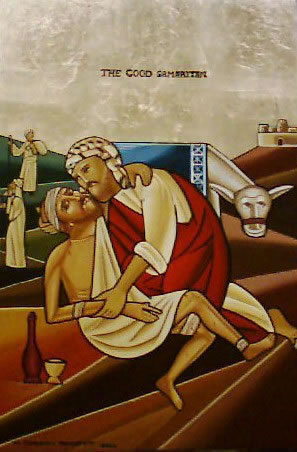
Of course, when we read Jesus’ parable about the Good Samaritan, we don’t find an other-worldly vision or a call to a higher moral plain. We simply see a person who stops and assists another person that has just been beaten and robbed. The actions of one led to the survival of the other. Although this is not pragmatism, the results of the command are pragmatic – a command not just to love one’s neighbor but to be a neighbor.
A Feminist Theologian Supports the Candidacy of Michele Bachmann, while an Evangelical Does Not
 I find it interesting and often amusing when the inner contradictions of our thought and worldview create a social space in which those once thought to be opponents become allies.
The BBC reported yesterday on the difficulty that Michele Bachmann is having with so-called “evangelical” Christians. You can listen to it between minutes 30:40 and 37:50 at: http://www.bbc.co.uk/iplayer/console/p00hj6t8. Although Bachmann defines herself as an “evangelical,” many of her fellow evangelicals do not support her candidacy for president of the United States simply because she is a woman. The Rev. Joan Brown Campbell, a Christian feminist, however, does support Bachmann’s candidacy – although she probably does not support Bachmann’s political agenda.
The Rev. William Einwechter of a Free Reformed Baptist Church gave voice to many “evangelicals” who do not believe that women should be in positions of authority in their family, in their church, or in civil society. The basis for Einwechter’s belief is his particular interpretation of the Bible, which subordinates women to men because man was created first, because they interpret women as being portrayed as submissive and in a domestic context in Proverbs 31 and Titus 2, and because female leadership is depicted negatively in Isaiah 3:12. This is a particular interpretation as it does not identify the wife’s leadership in Proverbs 31, does not note positive examples of women in authority over men as in Judges 5, and struggles to reconcile to their proposal Paul’s statement “for just as woman came from man, so man comes through woman; but all things come from God” (1 Corinthians 11:12). Moreover, Einwechter’s appeal to the Bible for models of civil leadership is weak because he does not consider the historical context as a limitation and contribution to God’s particular act or word for that time, person and setting. Also, God’s commandments concerning government are given within the context of the covenanted people ofIsrael; other forms of government, of which women sometimes led, are accepted as God-ordained (Romans 13).
Evangelicals, like Einwechter, support their position by appealing to the authority of Scripture as God’s definitive and infallible word. Einwechter believes that God’s word is not always understood, as in the case at hand, but should be obeyed even if it contradicts reason or experience. What Einwechter fails to see is that “God’s word” is always interpreted. And, on the basis of God’s word, I would interpret Einwechter’s interpretation as wrong. I do not find God doing anything in Scripture that is not explicable, and it seems that the appeal to a supra-rationality or a non-rationality ultimately leads to an anti-intellectual God and “stupid” and easily-manipulated Christians. I think that on the basis of their interpretive strategies they are unable to simultaneously subject women to men while viewing the killing one’s enemy (Joshua 8 ) or slavery (Titus 2) as being wrong. While I appreciate that Einwechter doesn’t think that political expediency should drive Christian faith, I actually think that he would be hard-pressed to support democracy and other American values with his biblical theology. What Michele Bachmann does for politics, Einwechter does for theology, causing me to distance myself from their brands of “evangelical.”
The Rev. Joan Brown Campbell affirms Bachmann’s candidacy as a woman because she finds gender mutuality in Scripture. Brown Campbell filters Scripture through God’s love and directs all action toward the Last Judgment in which each will give an account for how they treated the least of “God’s children.” While I would agree with Brown Campbell’s egalitarian view of women in church and society, I would also question her Biblical interpretation, which seems to presuppose much of liberal humanism. But, if I had to choose between Brown Campbell and Einwechter, I would find myself much closer to Brown Campbell, and, to my surprise, allies, in this instance, with Bachmann – and other female leaders in society.
From a Moldovan Bus Station
 I was visiting our young Word Made Flesh community in the Republic of Moldova last week. As we were getting ready to catch our bus back to Galați, I stopped for a few minutes to observe the old communist mosaic that stretched across the wall of the central bus station. Every society is supported by its myths, and every government propagates them. When I look at the communist art that is still hanging on, I can hear the stories and identify some of their beliefs.
The ideology promised civilization and industry, represented by the high-rise buildings and steel construction. Against the oppression of labor in capitalist societies, communism promoted the well-being of the citizen. A woman stands above from her steely balcony rather than under its weight. A worker reads as he welds, suggesting his work serves the higher purpose of cultivating through education. There is celebration and song. And families come together and grow, achieving a happier future generation.
Interestingly, there is no church, as in communism it is superfluous. Yet, the art itself is patterned after Orthodox mosaic iconography. And, like Orthodox icons, the people do not smile, although their demeanor gives an impression of happiness.
Like much of communist art, the shapes are geometric and controlled. And in this depiction of utopia, there is little nature. The sun, stars and moon appear to be ordered by man to function along with the planning of the society. The flowers are not rooted. There is much industry but little life. And this and images like this are what inspired the citizens of the Soviet era.
Former President Bill Clinton’s Use and Misuse of “Theology”
 A few weeks back, former President Bill Clinton said that the present political environment is poisonous. The Republicans and the Democrats have gone beyond ideology into a kind of political theology.Clinton said, “If we can break out of theology and get back to evidence and experience and the aspirations of ordinary people, I think we can have bipartisan cooperation.”
I appreciate Clinton’s naming of “theology” and his introducing of the concept into public discourse. However, his understanding of “theology” is incorrect. He understands “theology” as those beliefs and commitments for which there is no evidence. And he thinks that “theology” is a more extreme position beyond “ideology,” a relentless commitment to one’s own position. Contrary to Clinton’s view, each ideology is also based on beliefs and commitments for which there is no complete ground of evidence. Thus, some faith commitment is necessary for every ideology. Moreover, each ideology is itself a particular theology, addressing perspectives on justice, power and life. Each ideology flows from a particular understanding of “god,” and each ideology legitimizes and sanctions itself by appealing to its “god.”
Clinton’s observations and recommendations are themselves based on Clinton’s own theology.Clinton insists that we “look at the job numbers, look at the vested numbers, look at the growth numbers, look at the productivity numbers, look at the numbers.” Using these numbers requires a certain selection and a certain interpretation, and it portrays and sustains a certain theology. Clinton says, “It cannot be possible that either the Democrats or the Republicans are always wrong. It cannot be possible that a hundred percent of us are proceeding in bad faith.” Notice the bald theological language that Clinton uses: “faith.” The basis for discerning and determining what is right implies a “faith.”
Clinton urges us to move away from our theologies. This really is impossible. Politicians promote a certain view of society that reflects a particular view of “god” – even when the promoters claim to be secular or a-theistic. People cannot become less theological. Political views (just like social, economic, health policies, etc.) are always begging the question: which “god?” or whose “theology?” In a realm of lies, doublespeak and demagoguery, we should be calling for politicians and public personalities to be more theological. If theologies (i.e. ideologies, social visions, economic polices, etc) are clarified, policy objectives can be affirmed or disapproved in relation to the declared theologies. Deriving policy objectives from theology also creates space for negotiation, where policy objectives may be compromised without having to compromise one’s theology. And in democratic societies that include many diverse and contradicting theologies, compromise is essential.
In trying to have a gracious reading of Clinton’s view, I think that he is not really calling us to be less theological. Rather, he is inviting each party to become less entrenched in their own particular ideologies and to have the courage and willingness to consider the view of the other. Unfortunately, most political “gods” are jealous of their adherents and don’t allow them to consider others. As Christians, however, we can offer a unique perspective based on our theology that claims to know truth and to love those completely other than ourselves. In the sphere of larger society, we can call for candid speech and truth-telling, while naming and condemning discourse that is deceptive. And we can attempt to understand the perspectives of others and to build society together, even where there is disagreement. At this point, we can appropriate Clinton’s suggestion to identify what is right in those different than ourselves.
Advocating for the Spirit’s Power to Transform Society in the Cape Town Commitments
 Section 5 of the first part of the Cape Town Commitments affirms that “we love God the Holy Spirit.” I really appreciate the emphasis in this section on the Person of the Spirit and mission of the Spirit, which are not subordinated to the other Persons or actions of the Trinity.*
In the draft version of part a), which elaborates the activity of the Spirit in the Old Testament, the effects of the outpouring of the Spirit listed are “new life and fresh obedience to the people of God.” Keeping in mind the theme of the Congress, “Reconciliation,” I was surprised that there was no explicit reference to “sons and daughters” or “all humanity,” which are clearly articulated in the text from Joel 2. While section 5b) does mention the power of the Spirit for social engagement, I recommended that 5a) should mention accessibility of the Spirit which, by virtue of the Spirit’s outpouring, brings social transformation.
In the final version of the Cape Town Commitments, the document incorporated this recommendation, stating:
Prophets also looked to the coming age that would be marked by the outpouring of God’s Spirit, bringing new life, fresh obedience, and prophetic gifting to all the people of God, young and old, men and women.
* This is my second post on the Cape Town Commitments. Please refer to the first post on Mary for background.
Visitors

 fragments and reflections